If your child groans, argues, rushes, guesses, or shuts down as soon as you bring out a worksheet, you are not alone.
Many children do not dislike learning.
They dislike the way learning feels when it becomes too still, too repetitive, or too much like a test.
A child may enjoy stories, games, building, moving, talking, pretending, counting, sorting, and asking questions. But the moment learning is put on a worksheet, they may lose interest or confidence.
This can be frustrating for parents.
You may know your child needs practice. Maybe they need to work on letter sounds, reading, spelling, handwriting, number sense, counting, or simple math. But every time you try to sit down and practice, it turns into a battle.
That does not mean your child cannot learn.
It may simply mean they need a different way into learning.
For many children, short, playful, screen free learning activities can be much more effective than another worksheet. When learning includes movement, choice, play, and small successes, children are often more willing to join in.
The goal is not to make every moment educational.
The goal is to make learning feel possible.
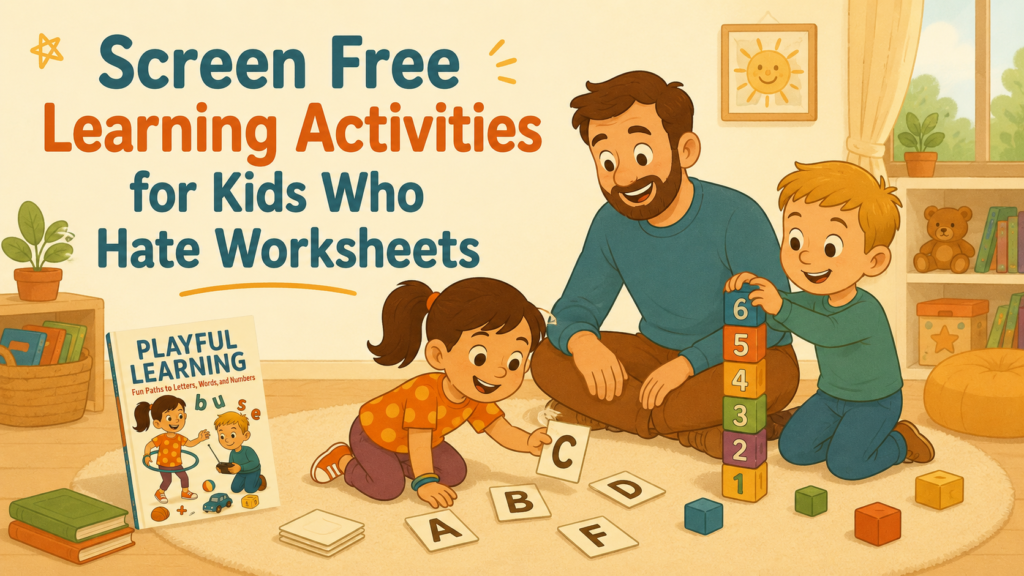
Why Some Kids Hate Worksheets
Worksheets can be useful.
They can help children practice specific skills. They can give structure. They can make it easy for adults to see what a child can do independently.
But worksheets are not the only way children learn.
For some children, worksheets quickly feel overwhelming. They may see a full page and feel defeated before they even begin. They may worry about getting answers wrong. They may become bored by repeated tasks. They may struggle to sit still long enough to finish.
Other children rush through worksheets just to be done.
They guess.
They skip.
They scribble.
They ask for help before trying.
They say, “I can’t do it.”
They say, “This is boring.”
They say, “I hate reading.”
They say, “I hate math.”
But often, the real problem is not reading or math.
The problem is how the practice feels.
A worksheet can make learning feel like performance. The child can see every blank space waiting for an answer. They may feel tested instead of supported.
And when children feel tested too often, they may begin to avoid learning altogether.
This is why it can be helpful to step back and ask:
Does my child hate learning?
Or does my child hate this format?
For many children, the answer is the second one.
Learning Does Not Have to Look Like School
Learning at home does not have to look like school.
You do not need to sit your child at a table for a long lesson. You do not need a full curriculum for every small skill. You do not need to turn your living room into a classroom.
Children can practice important skills through short, playful activities.
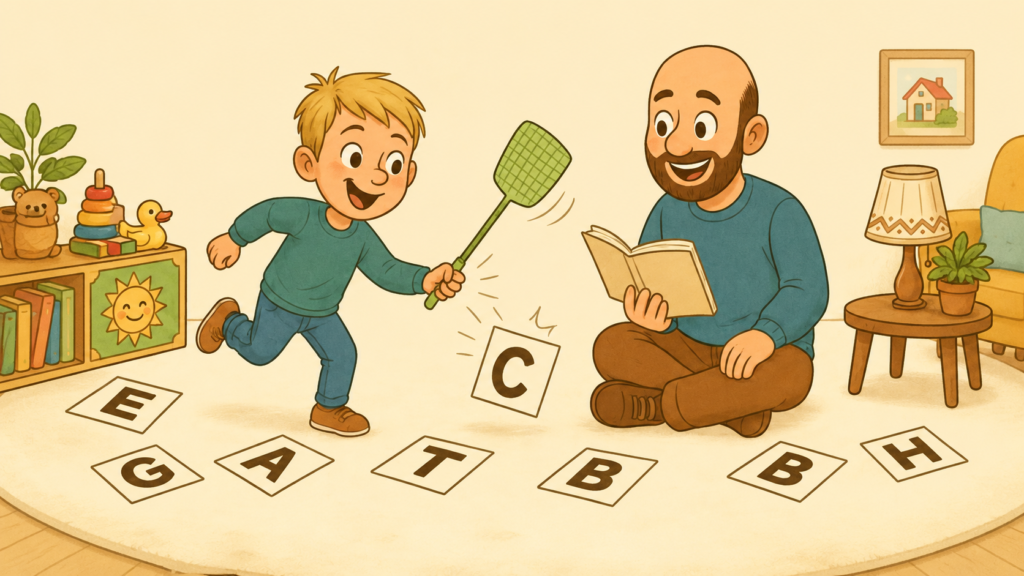
They can jump to letter sounds.
They can throw a beanbag at the right answer.
They can hunt for words around the room.
They can build silly sentences.
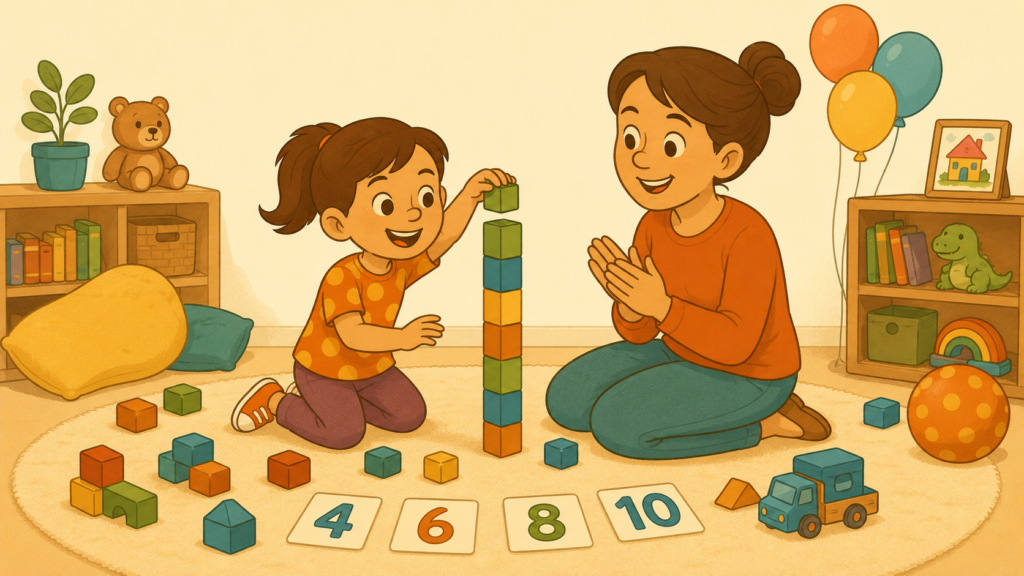
They can count steps, toys, blocks, or snacks.
They can move along a number line on the floor.
They can clap syllables.
They can sort objects by sound, color, size, shape, or number.
They can practice reading through games instead of pressure.
This kind of learning may look simple, but simple does not mean meaningless.
A child who jumps to the correct letter sound is practicing sound recognition.
A child who throws a ball at the right number is practicing attention, listening, and number knowledge.
A child who builds a silly sentence is practicing words, meaning, and sentence structure.
A child who counts toy animals is practicing one to one correspondence.
A child who matches words and pictures is practicing decoding and comprehension.
Learning can be active.
Learning can be playful.
Learning can happen in five minutes.
And for some children, that is exactly what makes it work.
What Play Based Learning Can Help With
Play based learning can support many early skills.
It can help children practice reading, math, memory, attention, language, problem solving, and confidence without making every activity feel like formal schoolwork.
For early reading, playful activities can help children practice:
letter sounds
sound blending
short words
rhyming
syllables
word recognition
simple sentences
spelling patterns
For early math, playful activities can help children practice:
counting
number recognition
number order
simple addition
simple subtraction
patterns
comparing amounts
mental math
Play can also help with skills that are harder to see on paper.
Children practice waiting, listening, taking turns, following instructions, trying again, noticing mistakes, and staying engaged.
These skills matter.
A child who avoids worksheets may still be able to learn when the practice feels active, concrete, and manageable.
For example, a child who refuses to write ten spelling words may enjoy jumping to the sounds in those words. A child who dislikes math worksheets may enjoy throwing a ball at number cards. A child who gets tired of reading practice may enjoy a word hunt around the room.
The skill is still there.
Only the format has changed.
Why Movement Helps Learning Feel Easier
Some children focus better when their body is involved.
This does not mean they are not trying when they move. It does not mean they are being difficult. It may mean that movement helps them stay engaged.
When children move during learning, the activity often feels less like a test. They get a physical task to do. They get a reason to repeat the same skill. They get a small challenge that feels more like a game than a lesson.
This can be especially helpful for children who:
find worksheets boring
have trouble sitting still
need frequent breaks
get frustrated quickly
avoid reading practice
rush through written tasks
lose confidence easily
learn better through doing
Movement can also make repetition feel more natural.
A child may not want to read the same word five times from a worksheet. But they may happily read five word cards if they are part of a treasure hunt.
A child may not want to answer ten math facts on paper. But they may enjoy solving ten quick number challenges if they get to jump, throw, move, or build something.
The practice is still practice.
It just feels different.
And that difference can matter a lot.
Simple Screen Free Learning Activities to Try
You do not need complicated materials to make learning more playful.
Many activities can be done with paper, sticky notes, toys, blocks, cards, a soft ball, or things you already have at home.
Here are five simple screen free learning activities to try.
1. Jump to the Sound
Write letters or letter combinations on pieces of paper.
Place them on the floor.
Say a sound, and let your child jump to the letter that makes that sound.
For example, you say:
“Find /m/.”
Your child jumps to the letter M.
You can make this easier by using only three or four letters at first. You can make it harder by adding more letters, digraphs, or short words.
This activity can help children practice letter sounds while moving.
It is especially useful for children who get tired of flashcards or table work.
Keep it short. Five minutes can be enough.
2. Throw the Answer
Place number cards, letter cards, word cards, or picture cards on the floor.
Ask a question.
Your child throws a soft ball, beanbag, or rolled up sock at the answer.
For reading practice, you might say:
“Throw to the word cat.”
For phonics practice, you might say:
“Throw to the word that starts with /s/.”
For math practice, you might say:
“Throw to the answer to 3 + 2.”
For number recognition, you might say:
“Throw to number 7.”
This activity gives children a reason to look carefully, listen, choose, and respond.
It also makes practice feel more like a game.
If your child gets frustrated easily, use questions they can mostly answer. The goal is not to trick them. The goal is to build confidence through successful practice.
3. Word Treasure Hunt
Write simple words on small cards or sticky notes.
Hide them around the room.
Let your child find one card at a time, bring it back, and read it with you.
For a new reader, use short and simple words, such as:
cat
dog
sun
run
sit
map
hat
You can also match the words to toys or pictures.
For example, your child finds the word dog and places it next to a toy dog.
This helps reading feel purposeful. The child is not just reading a list. They are finding, moving, matching, and making meaning.
You can also use this activity for sight words, spelling words, rhyming words, or vocabulary.
4. Number Line Walk
Make a number line on the floor.
You can use paper, sticky notes, painter’s tape, or number cards.
Ask your child to stand on a number.
Then give small challenges.
For example:
“Start on 3. Take two steps forward. Where are you now?”
Or:
“Start on 8. Take three steps back. What number did you land on?”
This helps children experience addition and subtraction physically.
Instead of only seeing numbers on a page, they move through the number sequence with their body.
You can keep it very simple for younger children:
“Can you jump to 5?”
“Can you stand on the number that comes after 6?”
“Can you find the number before 4?”
For older children, you can use skip counting, simple addition, subtraction, or number patterns.
5. Build a Silly Sentence
Write simple words on cards.
Use a few naming words, action words, and describing words.
For example:
The
funny
cat
can
jump
Let your child build a sentence and read it aloud.
Then change one word.
The funny cat can jump.
The funny dog can jump.
The funny dog can run.
The little dog can run.
Silly sentences often make children more willing to read, because the activity feels playful.
It also helps children understand that words work together to create meaning.
You can use this activity for early readers, spelling practice, grammar awareness, or sentence building.
The sentences do not need to be perfect at first.
They need to be readable, playful, and possible.
How to Use Playful Learning Activities at Home
You do not need a perfect learning routine.
You need small moments your child is willing to join.
For many families, five to ten minutes is a good place to start. A short activity that ends well is often better than a long session that ends in frustration.
Try this simple approach:
choose one skill to practice
choose one playful activity
keep the activity short
make it easy enough for success
help before frustration grows
repeat the same game another day
stop while your child still feels okay
The goal is not to finish a full lesson.
The goal is to help your child experience learning without immediate resistance.
You might say:
“Let’s try this for five minutes.”
Or:
“You only need to do three turns.”
Or:
“Let’s see if we can make this into a game.”
Or:
“We can stop before it gets too much.”
This lowers the pressure.
Children often participate more willingly when they know the activity will not go on forever.
It is also helpful to repeat activities.
Parents sometimes feel they need a new idea every day. But children often benefit from doing the same game several times. Repetition helps them understand the rules, feel more confident, and focus more on the learning skill.
If your child enjoys one activity, use it again.
You can change the words, numbers, sounds, or challenge while keeping the same game structure.
That makes learning easier for both of you.
What to Avoid
When a child already dislikes worksheets or formal practice, it is easy for learning time to become tense.
Try to avoid turning playful learning into another test.
Avoid:
long sessions
too many corrections
tasks that are too difficult
comparing your child with others
forcing the activity after frustration starts
using play only as a hidden worksheet
expecting perfect focus
making every answer feel high stakes
If your child makes a mistake, stay calm.
Mistakes are part of learning.
You can say:
“Let’s try that one again.”
Or:
“Look closely at the first sound.”
Or:
“Let’s do it together.”
Or:
“That was tricky. I’ll help.”
The tone matters.
A playful activity can stop feeling playful if the adult becomes too focused on right answers.
Of course, children do need to practice accurately. But confidence and willingness also matter. A child who feels safe enough to try is more likely to keep practicing.
If your child is becoming upset, it is usually better to stop early and return another day.
Stopping is not failure.
Sometimes stopping before frustration is what keeps learning possible tomorrow.
When Worksheets Can Still Be Useful
Worksheets are not bad.
Some children enjoy them. Some skills can be practiced well on paper. Worksheets can help with handwriting, independent practice, fine motor control, written answers, and review.
The problem is not the worksheet itself.
The problem is relying on worksheets when they are clearly creating resistance.
If your child can use worksheets calmly and successfully, they can be part of your learning routine.
But if every worksheet leads to tears, arguments, rushing, or shutdown, it may be time to add another kind of practice.
You can still return to paper later.
A playful activity can prepare the skill first.
For example, your child might practice letter sounds through jumping before writing them. They might practice number order by walking on a number line before completing a page of number problems. They might build silly sentences with word cards before writing sentences on paper.
Play and worksheets do not have to compete.
They can support each other.
But for many children, play is the easier starting point.
Why Small Playful Wins Matter
Small successes matter.
A child who says one sound correctly has made progress.
A child who reads one short word has made progress.
A child who solves one number problem has made progress.
A child who joins a learning game without arguing has made progress.
These moments may look small, but they can change how a child feels about learning.
When children feel successful, they are more likely to try again. When they feel defeated, they are more likely to avoid the task.
This is why playful learning can be so helpful.
It gives children a way to practice without feeling trapped by the page. It gives parents a way to help without turning every moment into a lesson. It makes learning feel lighter, more active, and more connected.
The goal is not to avoid challenge.
Children need challenge.
But challenge works best when it feels possible.
A child who feels, “I can try this,” is in a much better place to learn than a child who feels, “I always get this wrong.”
Small playful wins can build that feeling.
One game.
One word.
One sound.
One number.
One good moment.
That counts.
Final Thoughts
If your child hates worksheets, it does not mean they hate learning.
It may mean they need learning to feel more active, more playful, and more manageable.
Screen free learning activities can help children practice reading, math, attention, movement, and problem solving without turning every practice session into a battle.
You do not need long lessons at home.
You do not need to make everything perfect.
You can start with one simple game, one small skill, and a few minutes of calm practice.
Try jumping to letter sounds. Try throwing a soft ball at number cards. Try a word treasure hunt. Try walking on a number line. Try building silly sentences.
Notice what your child is willing to try.
Then build from there.
Learning does not always have to happen on a worksheet.
Sometimes it starts on the floor, in a game, through movement, with laughter, and with a child who suddenly thinks:
“I can do this.”
Great content! Keep up the good work!