This post contains affiliate links. If you make a purchase through one of these links, I may earn a small commission at no additional cost to you. I only recommend products that I believe may be useful to families.
Emotions can be difficult for young children to understand.
Feelings such as anger, worry, disappointment, excitement, and sadness are invisible. Children may notice that something feels uncomfortable in their body without knowing what the feeling is called, why it appeared, or what they can do next.
Simply telling a child to calm down, use their words, or make a better choice is rarely enough. Emotional skills need to be introduced, explored, and practised over time.
Games and playful activities can make that process easier.
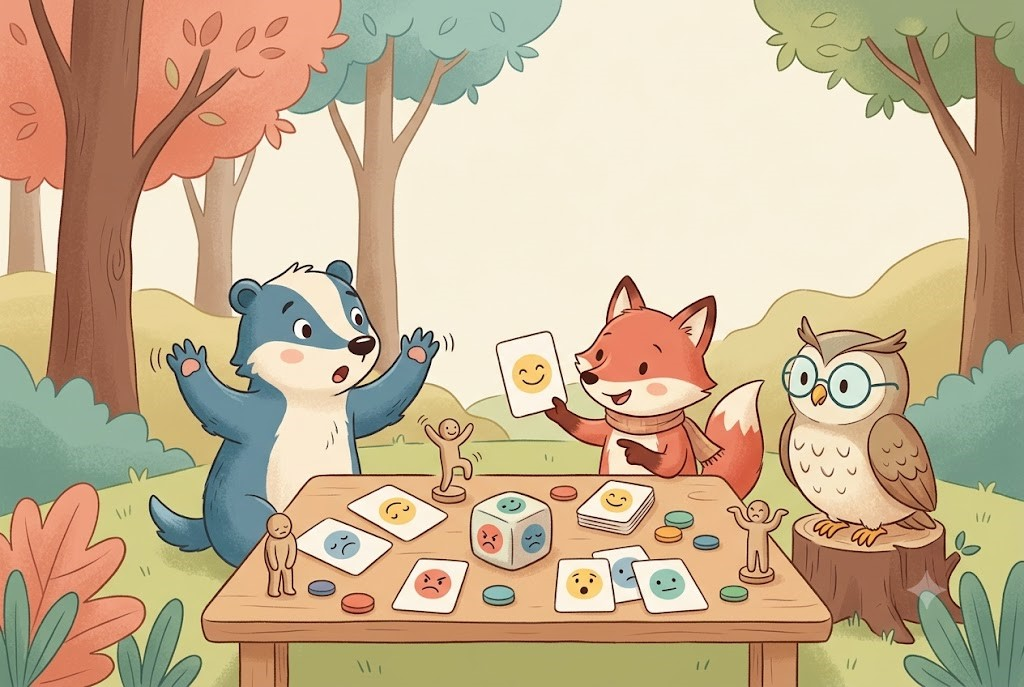
When children explore emotions through stories, movement, figurines, pictures, and imaginary situations, the conversation does not have to focus directly on something they have done wrong. They can first talk about a character, a scenario, or a game card. This creates emotional distance and makes the experience feel more like shared play than a lesson or interrogation.
The products in this guide use four different approaches:
- active play with scenarios and movement
- cooperative storytelling and memory
- hands-on play with expressive figurines
- practical calming and coping strategies
The guide also includes several free emotion activities that can be used without buying anything.
Quick Look at the Best Emotion Games and Activities
| Product | Best for | Approximate age | Main approach |
|---|---|---|---|
| My Feelings | Exploring emotions through active play | 4+ | Scenarios, movement, discussion, and regulation strategies |
| The Color Monster Board Game | Cooperative conversations about feelings | 3+ | Memory, storytelling, and shared play |
| All About Me Feelings Activity Set | Hands-on emotional learning for preschoolers | 3+ | Figurines, matching, sorting, and pretend play |
| Emotional Rollercoaster | Practising calming and coping strategies | School age | Problem-solving, breathing, and self-regulation |
For the broadest combination of emotional learning and active participation, My Feelings is the strongest overall option.
For younger children who prefer concrete materials and imaginative play, the All About Me Feelings Activity Set offers the greatest flexibility.
How These Games and Activities Were Chosen
The aim was not to find four products that work in exactly the same way.
Each recommendation supports a different part of emotional development. Some help children recognise and name feelings. Others encourage storytelling, perspective-taking, movement, or the practice of calming strategies.
The products were considered based on:
- how clearly they focus on emotions
- how actively children participate
- whether they make room for conversation without making the child feel tested
- the approximate age and developmental level they suit
- how easy they are to use repeatedly
- whether they can realistically work in family life
- how much they differ from the other recommendations
Games should not require children to reveal private or upsetting experiences. A child can learn a great deal by discussing fictional characters and imaginary situations without being asked to explain their own difficult moments.
The Best Games and Playful Activities for Teaching Kids About Emotions
1. My Feelings
Best overall for exploring emotions through active play
My Feelings offers one of the broadest approaches to learning about emotions through play.
The game combines illustrated emotional situations, movement activities, conversation, and possible regulation strategies. Rather than asking children only to identify whether someone feels happy, sad, or angry, it encourages them to explore what may have caused the feeling and what the person could do next.
That makes it useful for children who are ready to move beyond basic emotion naming.
How the game works
The game contains a large range of scenarios involving different feelings and social situations. Children can talk about how a character might feel, consider different reactions, and explore possible ways of coping.
Movement cards add a more active element. This can be particularly helpful for children who lose interest when emotional learning consists only of sitting and answering questions.
The game can therefore support several skills at the same time:
- identifying emotions
- considering why a feeling appeared
- noticing that people may react differently
- exploring socially appropriate responses
- learning possible regulation strategies
- taking turns and listening to other perspectives
Why it stands out
Many emotion resources rely heavily on discussion. My Feelings combines talking with physical participation and playful tasks.
That makes it a strong match for children who learn through doing and for families who want emotional learning to feel less formal.
It also offers enough content to be used repeatedly. Families do not need to use every card or rule during each session. Selecting a smaller number of scenarios can make the game easier for younger children or for children with shorter attention spans.
Best for: Families wanting a broad and active emotions game
Approximate age: 4+
Type: Board game with scenarios, movement, and coping strategies
Main strength: Combines emotional conversations with active play
What parents should know
This is a relatively extensive game. Younger children may need adults to simplify the rules, select a limited number of cards, or shorten the playing time.
The goal should not be to obtain a perfect answer from the child. A situation may produce several possible emotions, and different children may interpret the same event differently.
Adults can keep the game playful by asking questions such as:
- “What do you notice?”
- “How else might this person feel?”
- “What could happen next?”
- “Which idea would you like to try?”
2. The Color Monster Board Game
Best cooperative game for naming and sharing feelings
The Color Monster Board Game turns emotional learning into a cooperative family activity.
Rather than competing against one another, players work together to help organise different feelings. The game combines memory, colour matching, storytelling, and conversation.
The cooperative format is particularly well suited to an emotions game. It reduces the pressure of winning and losing and allows adults and children to focus on the discussion created by the game.
What children can practise
As the game progresses, children encounter different emotions and connect them with experiences or situations.
They may talk about moments when they felt:
- happy
- sad
- angry
- afraid
- calm
- confused
The exact conversation can be adapted to the child. A younger child may give a very simple example, while an older child may describe a more complicated situation.
Adults can model the activity first:
“I felt happy when we ate breakfast together.”
“I felt frustrated when I could not find my keys.”
“I felt calm when I sat outside for a few minutes.”
Simple examples show children how the game works without demanding that they immediately share something personal.
Why it stands out
The game feels like a genuine board game rather than a set of educational questions.
Children move pieces, remember positions, and work towards a shared goal. Emotional conversation is built into the activity instead of being added as a separate lesson.
This can be helpful for children who enjoy board games but become uncomfortable when an adult begins a direct conversation about feelings.
Best for: Younger children and families who enjoy cooperative games
Approximate age: 3+
Players: 2–5
Playtime: Approximately 25 minutes
Main strength: Makes emotional conversations part of a shared board game
What parents should know
The game works best when children are willing to contribute small examples or imaginary stories. However, they should not be pressured to discuss frightening, embarrassing, or private experiences.
A child can always talk about:
- a fictional character
- something that might happen to another child
- an animal or toy
- an imaginary situation
That still provides useful practice in identifying and discussing emotions.
See The Color Monster Board Game on Amazon
3. All About Me Feelings Activity Set
Best hands-on feelings activity for preschoolers
The All About Me Feelings Activity Set is different from the other recommendations because it is not primarily a board game.
The set includes colourful figurines with different facial expressions, together with activity ideas that can be used for matching, sorting, storytelling, and emotional play.
This open-ended structure makes it particularly suitable for preschoolers and children who prefer manipulating concrete objects rather than following a long set of rules.
Why hands-on play can help
Young children often understand an idea more easily when they can see and touch it.
A figurine with crossed arms, a frowning mouth, or a surprised expression gives the child something specific to notice. The child can then move the figure, place it in a story, or compare it with another expression.
The figures can be used for both adult-guided activities and free imaginative play.
Best for: Preschoolers who learn through hands-on and imaginative play
Approximate age: 3+
Type: Emotion figurines and activity cards
Main strength: Supports many different open-ended activities
Four ways to use the set
Match the feeling
Place several figurines on the table and ask the child to find two that appear to show the same emotion.
You can ask:
- “What do you notice about their faces?”
- “What makes them look similar?”
- “Could they be feeling something else?”
The purpose is observation, not finding one perfect answer.
Build a feelings family
Ask the child to choose several figurines and decide how each one feels.
The child can create a family, a classroom, a group of friends, or an imaginary team. Then ask what may have happened before the scene began.
This combines emotional vocabulary with storytelling and pretend play.
Create a mini problem
Choose one figurine and create a small, manageable problem:
“This character wanted the blue cup, but someone else took it first.”
Ask the child:
- How might the character feel?
- What could the character say?
- What might help?
- Could the character feel two things at once?
Sort and talk
The figurines can be sorted according to:
- colour
- facial expression
- feeling
- body position
- the child’s own categories
Sorting adds an early learning element while still creating opportunities to talk about emotions.
Why it stands out
This set does not limit children to one fixed game.
It can be used for emotional learning, pretend play, colour sorting, counting, matching, and storytelling. It may therefore have broader use in a preschool or homeschool environment than a product designed for only one activity.
What parents should know
The open-ended format is both its main strength and its limitation.
Adults who want a complete game with a clear beginning, goal, and ending may prefer The Color Monster Board Game or My Feelings.
The activity set is better suited to families who enjoy adapting materials and following the child’s interests.
See the All About Me Feelings Activity Set on Amazon
4. Emotional Rollercoaster
Best for practising calming and coping strategies
Emotional Rollercoaster focuses more directly on what children can do when emotions become intense.
While the other recommendations spend more time on identifying feelings, storytelling, and emotional conversations, this game introduces practical ideas connected to calming down, coping, and problem-solving.
It is therefore most relevant for children who already understand basic emotion words and are ready to explore possible responses.
What the game can support
The game includes activities and prompts related to areas such as:
- anger
- frustration
- calming the body
- breathing
- mindfulness
- problem-solving
- trying different coping strategies
- understanding that the same strategy does not work for everyone
One useful message is that emotional regulation is not about finding one technique that always works.
A child may prefer movement in one situation, quiet space in another, and support from an adult in a third. Exploring several strategies can help children build a wider range of options.
Why it stands out
This product moves beyond asking, “How do you feel?”
Instead, it encourages children to consider:
“What could you do when you feel this way?”
That makes it a useful next step for school-aged children who need more concrete practice with emotional regulation.
Best for: School-aged children who need practical regulation strategies
Approximate age: School age
Type: Board game focused on coping and problem-solving
Main strength: Helps children explore what they can do after recognising a feeling
What parents should know
The game has a more instructional and problem-focused tone than the other products.
It may be most useful when adults keep the atmosphere collaborative and avoid presenting a coping strategy as the one correct answer.
A child may reasonably say that a strategy does not help them. That can lead to a useful conversation about what they might try instead.
An emotion game can support learning at home, but it is not a substitute for individual professional support when emotional or behavioural difficulties are severe, persistent, or causing significant problems in daily life.
See Emotional Rollercoaster on Amazon
Which Emotion Game Is Right for Your Child?
The right product depends on what your child currently needs to practise.
Choose My Feelings if you want the broadest combination of scenarios, emotional vocabulary, movement, and possible coping strategies.
Choose The Color Monster Board Game if your younger child enjoys cooperative board games and storytelling.
Choose the All About Me Feelings Activity Set if your child prefers figurines, matching, sorting, and imaginative play.
Choose Emotional Rollercoaster if your school-aged child already recognises common feelings and is ready to explore calming and coping strategies.
The age recommendations are only a starting point. Consider the child’s:
- language level
- attention span
- comfort with personal conversations
- interest in rules and board games
- preference for movement or hands-on play
- ability to consider imaginary situations
Some families may benefit from combining approaches. A child could first use figurines to create a story about frustration and later practise a calming idea from a more structured game.
Free Playful Activities for Teaching Kids About Emotions
Products can be useful, but emotional learning does not require a purchased game.
The following activities can be adapted for different ages and used with materials already available at home.
Emotion Charades
Choose a feeling and show it using only your:
- face
- posture
- hands
- movement
- walking style
The other person guesses the feeling.
Afterward, ask:
- “What made you think it was anger?”
- “Could that expression also mean worry?”
- “Do all people look the same when they feel sad?”
This activity helps children notice facial expressions and body language while also showing that emotions do not look identical in every person.
Finish the Feelings Story
Begin a short story with an emotional situation:
“A child spent a long time building a tower, but it suddenly fell down.”
Ask the child to continue:
- How might the character feel?
- Why might they feel that way?
- What might they do first?
- What could help?
- Could another child feel differently in the same situation?
Other starting points might include:
- A friend does not want to play the same game.
- A child is about to start something new.
- Someone receives an unexpected present.
- A loud noise wakes a character at night.
- A child finally learns something they have practised for a long time.
Draw the Feeling
Ask the child to draw an emotion without drawing a face.
The feeling could become:
- weather
- an animal
- a colour
- a shape
- a place
- a type of movement
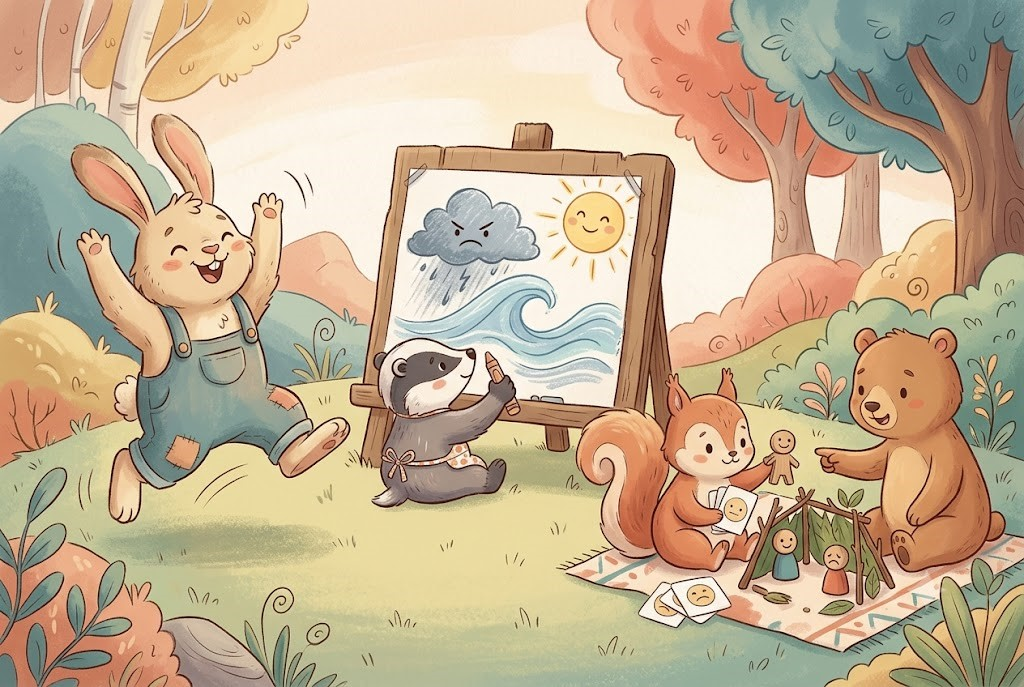
For example, anger might look like a storm, sharp red lines, or a large stomping creature. Calm might look like slow waves or soft circles.
There is no correct way to complete the activity. The drawing is a starting point for curiosity:
“Tell me about your picture.”
“Which part feels strongest?”
“What could help the storm become smaller?”
Emotion Detective
Use an illustration from an ordinary storybook, a family-friendly television scene, or a situation created with toys.
Look for clues:
- What does the character’s face show?
- What is their body doing?
- What just happened?
- What might they be thinking?
- What else could they be feeling?
Encourage more than one interpretation. A character looking down might be sad, worried, embarrassed, tired, or simply concentrating.
Move Like the Feeling
Turn emotions into movement.
Ask questions such as:
- How does excitement move?
- How does frustration walk?
- What does worry do with its hands?
- How would calm move across the room?
- Can your body slowly change from angry to relaxed?
This can help children connect emotions with physical sensations in a playful and non-threatening way.
It also works well for children who learn more easily through movement than through long conversations.
How to Use Emotion Games Without Making Them Feel Like a Test
Emotion games should feel exploratory rather than evaluative.
The goal is not to check whether the child knows the correct emotional vocabulary. It is to create opportunities to notice, wonder, talk, and practise.
Follow the child’s lead
A child may become interested in the game’s pieces, invent a different rule, or want to talk about one particular character.
That does not necessarily mean the activity has failed. Emotional learning can still happen through the child’s version of the play.
Accept more than one possible feeling
The same situation may cause anger in one child, sadness in another, and worry in a third.
Instead of saying, “No, the correct answer is angry,” ask:
“What made you think the character feels sad?”
The child may have noticed something you did not.
Share your own simple examples
Adults should participate rather than only question the child.
Use manageable, age-appropriate examples:
“I felt disappointed when it started raining before our walk.”
“I felt proud when I finished something difficult.”
“I felt nervous before meeting someone new.”
This shows that emotions belong to everyone.
Do not demand personal disclosures
A child can explore emotions without talking about private events.
They can discuss:
- the game character
- an invented child
- a toy
- an animal
- something that might happen in a story
Indirect conversations may eventually make it easier for the child to talk about their own experiences, but that should not be forced.
Stop while the activity is still enjoyable
A short positive session is often more useful than continuing until the child becomes tired or resistant.
It is better to play for ten enjoyable minutes and return another day than to turn the activity into a long lesson.
Emotion Games Can Support More Than Emotional Vocabulary
Emotion games are not only about learning words such as happy, angry, or worried.
Depending on the activity, children may also practise:
- communication
- listening
- perspective-taking
- memory
- turn-taking
- cooperation
- imaginative storytelling
- problem-solving
- body awareness
- flexible thinking
A cooperative board game can help children consider another person’s ideas. Figurines can support imaginative stories. Movement games can help children notice how tension and calm feel in the body.
Learning through play does not mean leaving children entirely on their own. It also does not mean turning every enjoyable activity into a formal lesson.
The adult can create an opportunity, join the play, and gently draw attention to useful ideas that appear naturally.
Related Resources
You may also find this guide helpful:
Best Anger Management Books for Kids Who Struggle With Big Feelings
More resources are coming soon:
Why Anger Is Okay: How to Help Kids Handle Big Feelings Safely
Why Learning Through Play Works for Young Children
Frequently Asked Questions
What age can children start learning about emotions through play?
Children can begin learning simple emotion words from an early age.
Toddlers and preschoolers may start by recognising basic facial expressions and using words such as happy, sad, angry, scared, and calm.
Older children can explore more complex emotions, mixed feelings, social situations, and different coping strategies.
The activity should match the child’s language, attention, and developmental level rather than relying only on the age printed on a product.
Are emotion games helpful if my child does not like talking about feelings?
They can be.
A game gives the child something external to focus on. Instead of answering a direct question about their own feelings, the child can talk about a character, picture, figurine, or imaginary scenario.
Some children also communicate more comfortably while moving or playing than during a face-to-face conversation.
Do not use the game as a disguised attempt to make the child reveal something. Allow indirect participation to be enough.
Should I correct my child if they name the “wrong” emotion?
Not immediately.
Ask what the child noticed and why they chose that feeling.
Emotional situations are often open to interpretation. A person who appears angry may also feel hurt, afraid, embarrassed, or disappointed.
You can introduce another possibility without dismissing the child’s answer:
“I can see why you thought the character was sad. I also wondered whether they might feel frustrated.”
Can emotion games help with anger?
They may help children build some of the skills involved in managing anger.
For example, a game can help a child:
- recognise early feelings
- distinguish anger from disappointment or worry
- notice physical signs
- consider several possible responses
- practise calming strategies when they are already calm
Games do not prevent all angry reactions, and children should not be expected to remain calm at all times.
Can an emotion game replace professional support?
No.
Games can be useful educational resources and family activities. They are not a replacement for individual assessment or treatment.
Consider seeking professional guidance if emotional or behavioural reactions are frequent, severe, harmful, or significantly affect family life, friendships, school, or the child’s general wellbeing.
Final Thoughts
The most useful emotion game is the one that matches how your child learns and what they are ready to practise.
My Feelings is the strongest overall choice for families wanting a broad combination of scenarios, movement, emotional vocabulary, and regulation strategies.
The Color Monster Board Game offers a gentler cooperative experience for younger children who enjoy memory games and storytelling.
The All About Me Feelings Activity Set is ideal for preschoolers who learn through figurines, sorting, matching, and imaginative play.
Emotional Rollercoaster is the most relevant option for school-aged children who are ready to explore practical calming and coping strategies.
Children do not need to master every feeling or respond calmly in every situation.
The goal is to gradually give them more language, more understanding, and more possible responses to draw on as they grow.
This post contains affiliate links. If you purchase a product through one of these links, I may earn a small commission at no extra cost to you. Recommendations are based on relevance and potential usefulness to families, not solely on potential affiliate earnings.