Playful Learning was created by the author of this blog. This post gives you a closer look at what the ebook contains, how the activities work, and which families it may suit.
Learning practice does not always need to look like traditional schoolwork.
Some children enjoy sitting down with a worksheet and completing one task after another. Others become more engaged when letters, words, and numbers are turned into a game, a challenge, a story, or something they can explore with their hands.
Neither approach is automatically right for every child. The important thing is finding ways to practise that match how the child learns and what helps them remain interested.
That is the idea behind Playful Learning.
The ebook brings together reading and math activities that use games, imagination, simple materials, and shared play. Some involve movement, while others take place around a table or through role-play, drawing, matching, sorting, and problem-solving.
The common principle is not that children must always be physically active. It is that they participate in the learning rather than simply completing repeated exercises on a page.
This guide takes you inside the ebook, explains how it is intended to be used, and shares a closer look at several of the activities.
Get the Playful Learning ebook on amzon here
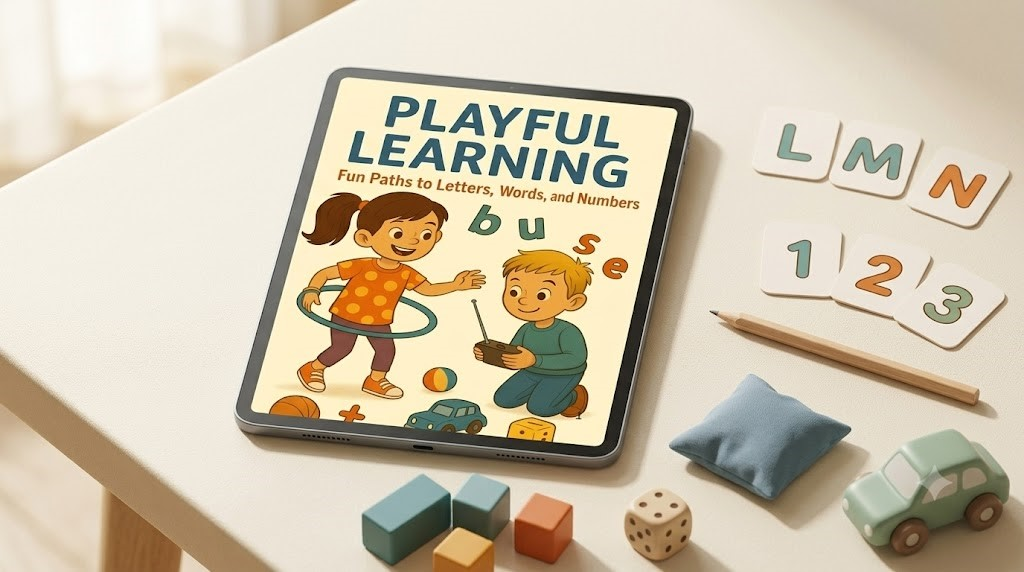
What Is the Playful Learning Ebook?
Playful Learning: Fun Paths to Letters, Words, and Numbers is a digital activity book for adults who want practical ideas for making early literacy and math practice more playful.
It is not a traditional workbook that children complete directly on the page. Instead, the ebook gives the adult instructions for setting up games and activities using materials such as letter cards, number cards, paper, pencils, sticky notes, balls, toys, and ordinary household objects.
The adult can choose an activity based on:
- the skill the child is practising
- the materials available
- the amount of time available
- whether the child wants a quiet or more active activity
- the child’s current interests and energy level
The ebook can be opened on a phone, tablet, or computer. The adult reads the instructions, gathers the necessary materials, and introduces the activity to the child.
The child does not work through the ebook as a digital exercise. The ebook acts as a collection of ideas and instructions for play that happens outside the document itself.
Why I Created Playful Learning
Before becoming a parent, I worked for more than ten years as an educator in schools and after-school settings.
My work included supporting children’s learning, well-being, behavior, and participation in play. During that time, I developed and adapted many educational games, particularly within early literacy and math.
The same idea returned when I later became a father.
Learning at home did not need to recreate a classroom. It could happen through games, movement, storytelling, humor, everyday objects, and time spent together.
However, continually inventing new activities can be difficult for parents and educators. Even when you know that a child would benefit from more playful practice, it is not always easy to think of a suitable game at the end of a busy day.
I created Playful Learning to gather these ideas in one place.
The aim is to give adults practical activities they can take from the book and use without needing to design a complete lesson themselves.
Who Is the Ebook For?
Playful Learning is intended for adults supporting children with early reading and math skills.
It may be particularly useful for children who:
- enjoy games and small challenges
- quickly lose interest in repetitive exercises
- benefit from practising the same skill in different ways
- like using cards, toys, drawings, or concrete materials
- enjoy learning together with an adult
- prefer shorter, focused activities
- respond well to imagination, role-play, or movement
- need more variety alongside other forms of learning
The ebook can be used by:
- parents
- teachers
- educators
- homeschool families
- after-school professionals
- adults supporting a child who needs extra practice
It is not only for children who dislike worksheets.
A child may be perfectly comfortable with traditional schoolwork and still benefit from experiencing letters, sounds, words, and numbers through play. Different formats help children meet the same skill from several angles.
What Is Inside the Playful Learning Ebook?
The activities cover early literacy and math through different forms of play.
Rather than requiring every activity to follow the same structure, the ebook includes a mixture of:
- Letter and number card games
- matching activities
- throwing and aiming games
- role-play
- sorting
- movement
- counting
- building
- simple tabletop games
This variation makes it possible to choose an activity that fits both the learning goal and the child.
Reading and Early Literacy Activities
The literacy activities support areas such as:
- letter recognition
- connecting letters with their sounds
- early phonics practice
- listening for sounds
- forming and building words
- spelling
- early reading confidence
- paying attention to the sounds inside words
Some activities use physical letter cards placed on the floor, while others can be played at a table.
A child may be asked to find, match, hear, build, say, or respond to a letter or sound. These actions make the child an active participant rather than someone who only listens to an explanation.
Math Activities
The math activities introduce skills through games and familiar situations.
Depending on the activity, children may practise:
- recognising numbers
- counting forwards and backwards
- understanding quantities
- addition
- subtraction
- comparing amounts
- finding the answer to simple problems
- connecting a written number with an actual quantity
- using math in pretend play
Numbers can be explored through movement, cards, role-play, or practical challenges.
A child might jump along a number path, throw toward the correct answer, or use pretend groceries to explore addition and subtraction.
Different Ways to Play and Learn
Play based learning does not always mean running, jumping, or throwing.
Some children enjoy activities that involve their whole body. Others become deeply engaged in a quiet role-play game or a small challenge at the table.
The ebook includes both.
Some activities involve:
- movement across a room
- aiming or throwing
- jumping between numbers or letters
Others involve:
- arranging letter and number cards
- pretending to shop
- building words
- sorting objects
The shared feature is that the learning skill becomes part of a meaningful activity.
What Makes Playful Learning Different?
There are many ways to help a child practise reading and math. Playful Learning is not designed to replace every other learning resource.
Its role is to provide an alternative when adults want practice to feel more playful, flexible, and interactive.
Learning Is Built Into the Game
The educational goal is part of the activity rather than something added afterward.
In a letter game, the child needs to recognise a letter or sound in order to play. In a math game, the child may need to calculate an answer before throwing, moving, choosing, or collecting an object.
The child is still practising a real skill, but the practice has a purpose inside the game.
Children Participate Actively
Active participation does not only refer to physical activity.
A child participates actively when they:
- make a choice
- search for an answer
- predict what will happen
- build something
- solve a problem
- respond to another player
- adapt a strategy
- move or manipulate materials
This can make practice feel more meaningful than repeatedly answering similar questions.
Activities Can Be Adapted
The games are intended to be flexible.
An adult can often adapt an activity by:
- using fewer letters or numbers
- choosing easier or more difficult examples
- reducing the number of rules
- playing for a shorter time
- adding an extra challenge
- allowing the child to take the adult’s role
- repeating a favourite version
The same basic game may therefore be useful at more than one stage of learning.
The Materials Are Simple
Many educational activities look appealing but require specialist equipment, printed packs, or materials families do not already own.
Most of the activities in Playful Learning use ordinary items such as:
- paper
- pencils
- homemade cards
- sticky notes
- tape
- dice
- a ball or beanbag
- toys
- small counters
- bottles or cones
- household objects
The intention is to make the activities realistic to use at home, in school, or in an after-school setting.
Learning Becomes Something You Do Together
Many activities are designed for a child and adult to play together.
This creates an opportunity for the adult to notice:
- what the child already understands
- which parts are difficult
- what motivates the child
- whether the activity needs to be adapted
- how the child approaches a problem
It also allows the child to experience learning as shared time rather than only as a task they must complete.
A Closer Look at Three Activities
The following examples show three different ways the ebook combines play with learning.
They are not intended to represent every activity in the book. Instead, they demonstrate the variation between literacy, role-play, math, and movement.
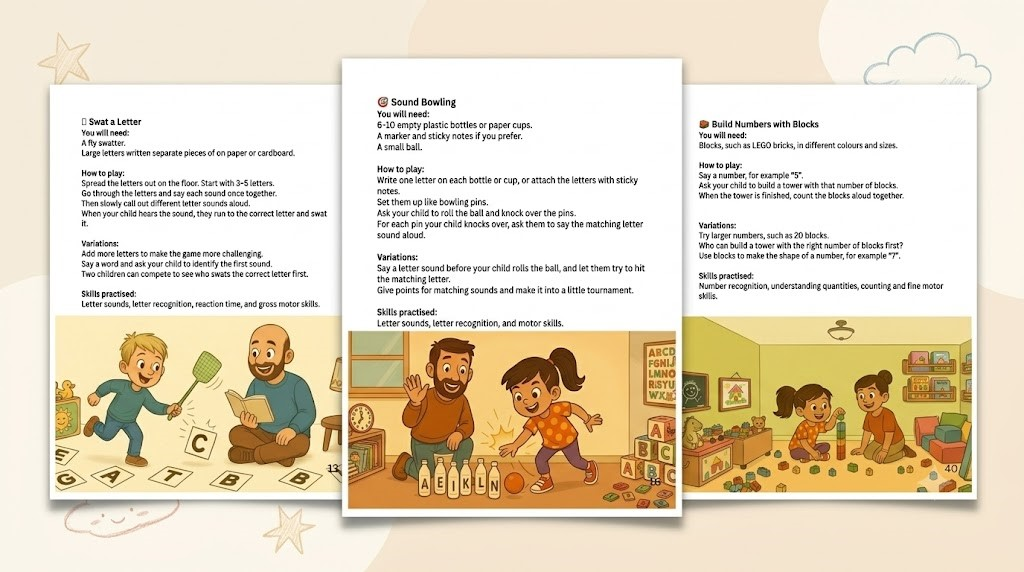
Swat the Letter
What the child practises
Swat the Letter helps children practise letter recognition and connect letters with their sounds.
It is particularly useful when a child is becoming familiar with a small selection of letters and needs repeated exposure without completing the same type of paper exercise.
How the activity works
Letter cards are placed where the child can see and reach them.
The adult says a letter or letter sound, and the child identifies the correct card by moving toward it and swatting or touching it.
The game can begin with only three to five letters. More can be added as the child becomes confident.
Why children may enjoy it
The child is not simply asked to name one card after another.
There is an element of:
- searching
- anticipation
- quick decision-making
- movement
- playful competition against their own previous attempts
The adult can also allow the child to call out a sound while the adult finds the letter. Changing roles often makes an activity feel more like a shared game.
Materials
- large homemade letter cards
- a safe object for pointing or swatting, depending on the version used
- space on the floor or table
The full ebook includes the activity instructions, learning purpose, and ideas for adjusting the level.
Shopping Math
What the child practises
Shopping Math uses pretend play to practise:
- counting
- addition
- subtraction
- understanding quantities
- concentration
How the activity works
Small objects are used as pretend groceries.
These might include toy food, blocks, picture cards, or other safe household objects. The child places items in a basket, bag, or shopping box while responding to small math situations.
For example, the adult may ask the child to collect two apples and three bananas or to begin with six items and return two.
The math becomes part of a familiar pretend scenario.
Why children may enjoy it
This activity demonstrates that play based learning does not need to involve a large amount of physical movement.
The child can sit at a table or play on the floor while using:
- imagination
- role-play
- concrete objects
- small mathematical challenges
The activity may feel more meaningful because the numbers refer to objects the child can touch, move, count, and “buy.”
The adult and child can also exchange roles, allowing the child to become the shopkeeper and create math problems for the adult.
Materials
- toy food, blocks, or picture cards
- a small basket, bag, or box
- optional homemade price or number cards
The complete instructions and suggested variations are included in the ebook.
Throw the Answer
What the child practises
Throw the Answer combines simple addition or subtraction with aiming, concentration, and motor skills.
How the activity works
Number cards or sticky notes are placed as targets. The adult gives the child a math problem, and the child throws a ball or beanbag toward the card showing the correct answer.
For example, the adult might ask:
“What is four plus three?”
The child calculates the answer and aims for the number seven.
The numbers can be adapted to the child’s current level. Some children may work with numbers from zero to ten, while others can use larger numbers or more difficult calculations.
Why children may enjoy it
The answer leads directly into an action.
Instead of giving a verbal answer and moving to the next question, the child:
- solves the problem
- locates the number
- aims
- throws
- sees the result
This can make repeated math practice feel less repetitive.
It may be especially appealing to children who enjoy aiming games or who find it easier to concentrate when physical activity is part of the task.
Materials
- a ball or beanbag
- number cards or sticky notes
- tape, cones, or bottles to organise the targets
The ebook includes the complete setup, instructions, variations, and skills practised.
What Materials Will You Need?
Most activities do not require a separate educational kit.
Typical materials include:
- paper
- pencils or crayons
- sticky notes
- homemade number and letter cards
- dice
- tape
- a ball or beanbag
- counters
- toys
- blocks
- baskets or small boxes
- household objects
Each activity has its own materials list, so families do not need to prepare everything in advance.
Some games need little more than paper and a pencil. Others may require space to move, a collection of cards, or a few objects for pretend play.
Adults can also substitute materials.
A rolled-up pair of socks might replace a beanbag. Homemade paper cards can replace printed flashcards. Toys or building blocks can become groceries, counters, or game pieces.
The learning idea matters more than having one exact item.
How to Use the Ebook at Home
The ebook is designed as a flexible activity collection rather than a course that must be completed in order.
Choose an Activity Based on the Skill
Begin with the learning area the child currently needs to practise.
For example:
- letter recognition
- letter sounds
- word building
- counting
- addition
- subtraction
Then choose an activity that matches the child’s interests and the materials available.
Begin With a Small Number of Elements
A game does not become more educational simply because it contains many cards, numbers, or rules.
When introducing a letter activity, it may be helpful to begin with only three to five letters.
When introducing a math game, use numbers or calculations the child can approach with some confidence.
The game can become more difficult later.
Keep the Activity Manageable
Five or ten positive minutes can be more valuable than continuing until the child loses interest.
The activities do not need to become long lessons. They can be used as short learning moments during the week.
Repeat Favourite Games
Children often enjoy repetition when they like the game itself.
Repeating an activity gives the child another opportunity to practise the skill and become more confident with the rules.
The adult can gradually:
- add new letters
- use larger numbers
- introduce a time challenge
- change roles
- let the child create the questions
- combine two skills
Follow the Child’s Preferred Style of Play
One child may immediately choose the throwing or jumping games.
Another may prefer:
- pretend shops
- cards
- drawing
- matching
- word building
- quiet tabletop challenges
There is no requirement to begin with the most active activities.
A useful starting point is the type of play the child already enjoys.
Adapt Rather Than Abandon
An activity may be too easy, too difficult, too long, or too complicated in its original form.
That does not necessarily mean it is unsuitable.
Try:
- fewer cards
- easier questions
- shorter rounds
- more adult modelling
- a cooperative version
- allowing the child to lead
- removing one rule
Small changes can make the same activity accessible to a wider range of children.
Play Based Learning Does Not Always Mean Movement
Movement is an important part of several activities in Playful Learning, but it is not the definition of play based learning.
A child can also learn playfully while sitting at a table or on the floor.
Play may involve:
- creating an imaginary shop
- building a word from letter cards
- matching objects
- solving a challenge
- sorting items
- drawing
- cooperating with another person
- taking on a role
What makes the activity playful is not necessarily how much the child moves.
It is the presence of participation, choice, imagination, curiosity, challenge, and enjoyment.
This is why the ebook contains a combination of movement-based games and quieter activities.
Is Playful Learning a Screen Free Resource?
Playful Learning is a digital ebook, so an adult needs a phone, tablet, or computer to access the instructions unless the relevant pages are printed.
It would therefore not be accurate to describe the ebook itself as completely screen free.
However, the activities are not digital games, and children do not complete them inside an app or on a screen.
Once an adult has selected an activity, the child participates through:
- physical materials
- conversation
- cards
- role-play
- problem-solving
- movement
The screen is used to access the guide, not as the main learning activity for the child.
Who Might Prefer a Different Resource?
Playful Learning will not be the right format for every family.
You may prefer a different resource if you are looking for:
- a traditional workbook
- pages the child completes directly
- a structured curriculum that must be followed in order
- an educational app
- activities the child can always complete independently
- a printable pack containing all finished game materials
The ebook is better suited to adults who want:
- a flexible collection of ideas
- activities they can choose according to need
- games they can adapt
- shared learning with a child
- reading and math practice through different forms of play
- activities using simple materials
Most games require at least a small amount of adult preparation or participation.
For many families, that shared element is part of the value. For others, a more independent workbook may be more practical.
Frequently Asked Questions
What age is the Playful Learning ebook for?
The ebook focuses on early literacy and math, but the appropriate level depends on the child’s current skills rather than age alone.
Activities can often be made easier or more challenging by changing the letters, words, numbers, calculations, or number of rules used.
Does the ebook include both reading and math activities?
Yes.
The ebook includes early literacy activities involving letters, sounds, words, and reading-related skills, together with math activities involving numbers, quantities, counting, addition, and subtraction.
Is Playful Learning a workbook?
No.
It is an activity guide rather than a workbook children complete directly on the page.
The ebook provides instructions for adults to set up games and learning activities.
Do I need special materials?
Most activities use simple materials that families, schools, or after-school settings may already have.
Examples include paper, pencils, homemade cards, sticky notes, toys, blocks, dice, balls, beanbags, and small household objects.
Do we need to complete the ebook in order?
No.
The ebook is designed as a flexible collection.
Adults can choose activities according to the child’s current learning goals, interests, and energy level.
Does every activity involve movement?
No.
Some activities involve throwing, jumping, aiming, or moving between cards.
Others use pretend play, drawing, storytelling, matching, sorting, building, or tabletop games.
Can the activities be used with siblings or small groups?
Many of the activities can be adapted for more than one child.
Children may:
- take turns
- work together
- compete in a friendly way
- create questions for one another
- form small teams
The adult may need to adjust the rules so that each child works at an appropriate level.
Does the child need to use the ebook on a screen?
No.
An adult normally uses a device to read the instructions. The child then completes the activity using physical materials, play, and interaction.
Printing selected pages is another option for adults who prefer not to refer to a device during the activity.
Final Thoughts
Playful Learning was created for families and professionals who want reading and math practice to feel more varied, practical, and connected to play.
The activities do not all look the same.
Some use movement. Others use:
- cards
- role-play
- sorting
- building
- pretend situations
- tabletop games
This variation makes it possible to choose activities that match both the skill being practised and the way the child enjoys learning.
The ebook is not intended to remove every challenge from learning. Children still need opportunities to concentrate, practise, make mistakes, and try again.
The difference is that these experiences take place inside a game or shared activity, where practice can feel more purposeful and engaging.
Families who want a traditional workbook may prefer another format. But for adults looking for flexible ideas that turn letters, words, and numbers into something children can explore through play, Playful Learning may be a useful addition to their learning resources.
[Get the Playful Learning Ebook on Amazon]
Playful Learning was created by the author of this blog. This post is intended to provide a transparent overview of the ebook, its activities, and the type of families it may suit.