Anger can be one of the hardest emotions for adults to watch in a child.
It can be loud. It can arrive suddenly. A child who was happily playing a few minutes earlier may start shouting because it is time to leave, throw a toy after losing a game, or become furious because a sibling touched something they were building.
In those moments, it is natural to focus on stopping the anger.
But anger itself is not the problem.
Anger is a normal human emotion. Children can feel angry when they are frustrated, disappointed, worried, overwhelmed, treated unfairly, or unable to make something happen the way they expected.
What children need to learn is not how to never feel angry.
They need to gradually learn how to recognize anger, understand what is happening, express it safely, and decide what to do next.
That distinction matters.
Anger is a feeling. Hitting, hurting, threatening, or breaking things are behaviors. Children are allowed to feel angry while still learning limits around what they do with that anger.
Helping children develop those skills takes time. It happens through calm adult support, clear boundaries, repeated practice, and many ordinary moments when nobody is actually angry.
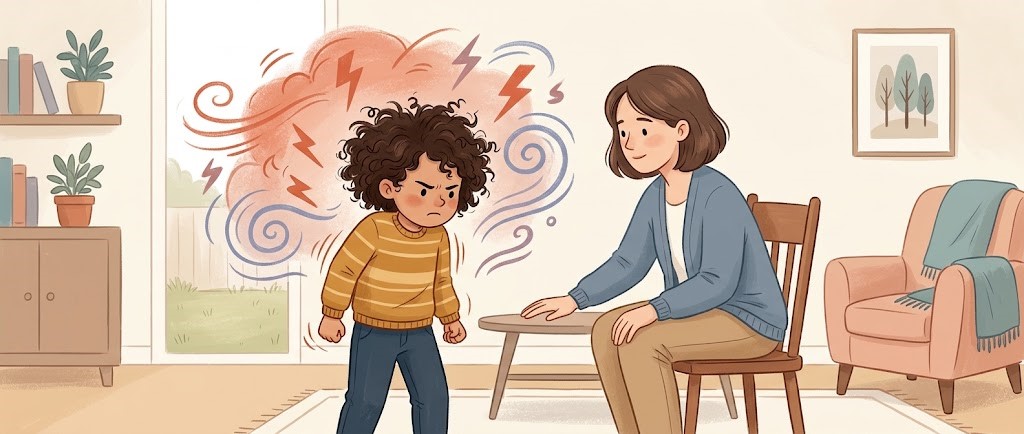
Why Do Kids Get Angry?
Sometimes the reason is obvious.
A sibling grabbed the toy.
The child lost the game.
It is time to turn off the television.
They wanted another cookie and the answer was no.
At other times, the reaction seems much bigger than the event that triggered it.
That is because anger is often only the most visible part of what is happening.
A child may become angry because they are:
- frustrated
- disappointed
- embarrassed
- worried
- tired
- hungry
- overstimulated
- feeling left out
- struggling with a task
- finding a transition difficult
- feeling misunderstood
- unable to explain what they need
- upset about something that happened earlier
A child who shouts because a block tower falls down may not simply be angry about the blocks.
They may already be tired after a long day. They may have rebuilt the tower several times. They may have imagined exactly how it should look and feel unable to make it work.
Adults can often see that complexity.
Young children may only experience:
“Everything feels wrong.”
Anger can also appear when children do not yet have the words, problem-solving skills, or emotional regulation skills to respond in another way.
That does not mean difficult behavior should be ignored.
It means that understanding what is underneath the behavior can help us teach a more useful response.
Anger Is Okay, but Not Every Reaction Is
Looking for practical ways to help your child explore big feelings?
If your child learns well through stories, see my guide to Best Anger Management Books for Kids Who Struggle With Big Feelings.
If your child prefers hands-on learning, explore Best Games and Playful Activities for Teaching Kids About Emotions.
One of the most important lessons we can give children is that feelings and actions are not the same thing.
A child can be furious.
A child cannot hit another person because they are furious.
Both messages can exist at the same time.
You might say:
“You can be angry. I won’t let you hit.”
Or:
“I know you’re really mad that the game is over. It’s still not okay to throw the controller.”
Or simply:
“Angry is okay. Hurting is not.”
This approach does not excuse the behavior.
It actually makes the boundary clearer.
Instead of telling the child that the feeling itself is wrong, we separate the emotion from the action and show them exactly what needs to change.
The message becomes:
You are allowed to have the feeling. You are still learning what to do with it.
That is very different from:
“Stop being angry.”
Children cannot simply switch emotions off because an adult tells them to.
What they can gradually learn is how to respond differently when those emotions appear.
Validating a Feeling Is Not the Same as Giving In
This distinction can be difficult for adults because validation sometimes sounds as if we are agreeing with the child.
We are not.
You can say:
“You’re really disappointed that we have to leave.”
and still leave.
You can say:
“You wanted that toy and you’re angry that I said no.”
and still say no.
You can say:
“I understand why you’re frustrated.”
without deciding that the child’s behavior was acceptable.
Validation means:
I can see that this feels difficult for you.
It does not mean:
You can have whatever you want because you are upset.
Children need both empathy and boundaries.
What Anger Can Feel Like in a Child’s Body
Before children can manage anger, they need to become better at noticing it.
Adults often recognize that anger is building before children do.
We hear the voice getting louder.
We notice the body becoming tense.
We see the hands clench or the movements become rougher.
Helping children notice these early signals can give them more time to use a strategy before anger becomes overwhelming.
Anger might feel like:
- hot cheeks
- a tight jaw
- clenched fists
- tense shoulders
- a fast heartbeat
- a strange feeling in the stomach
- wanting to move very quickly
- wanting to push or throw something
- a louder voice
- difficulty listening
- feeling as if everything suddenly becomes irritating
Not every child experiences anger in the same way.
Some become very physical.
Others go quiet.
Some cry.
Some argue.
Some want to leave the room.
Some children barely notice that they are becoming angry until the feeling is already very intense.
When everyone is calm, you can ask:
“What happens in your body when you start getting really angry?”
A child might initially say:
“I don’t know.”
That is fine.
You can help them notice over time:
“I noticed your voice became much louder before you threw the toy.”
Or:
“Your hands were really tight when you were frustrated.”
The goal is not to monitor the child for mistakes.
It is to help them recognize their own warning signs.
Try an Anger Scale
Some children find it easier to think about anger as something that grows.
You could use a simple scale:
1: Calm
2: Annoyed
3: Frustrated
4: Very angry
5: Completely overwhelmed
You do not need to ask the child for a number every time they become upset.
The scale simply gives you another way to talk about how feelings change.
A child who can recognize:
“I’m getting to a three”
has more options than a child who only realizes they are angry after reaching a five.
Regulation Comes Before Reasoning
When a child is extremely upset, it is tempting to start explaining.
“You know you are not allowed to do that.”
“Why did you behave like this?”
“Think about how your brother feels.”
“You need to apologize right now.”
Those conversations may be important.
But the middle of an intense emotional reaction is usually the wrong time for them.
When a child is overwhelmed, they may have difficulty listening, reflecting, solving problems, or considering someone else’s perspective.
In that moment, the priorities are simpler.
During the Big Feeling
Focus first on:
- keeping everyone safe
- using fewer words
- speaking calmly
- reducing unnecessary stimulation
- giving physical space if the child needs it
- staying nearby if the child finds that reassuring
- preventing hitting, throwing, or other unsafe behavior
You may only need to say:
“I’m here.”
“I won’t let you hit.”
“We can talk when your body is calmer.”
This is not the time for a ten-minute explanation.
After the Child Is Calm
Later, you can return to what happened.
That is the time to explore:
- what triggered the anger
- what the child noticed in their body
- what they did
- what was okay and what was not
- what might help next time
- whether anything needs to be repaired
The teaching happens when the child is able to participate in it.
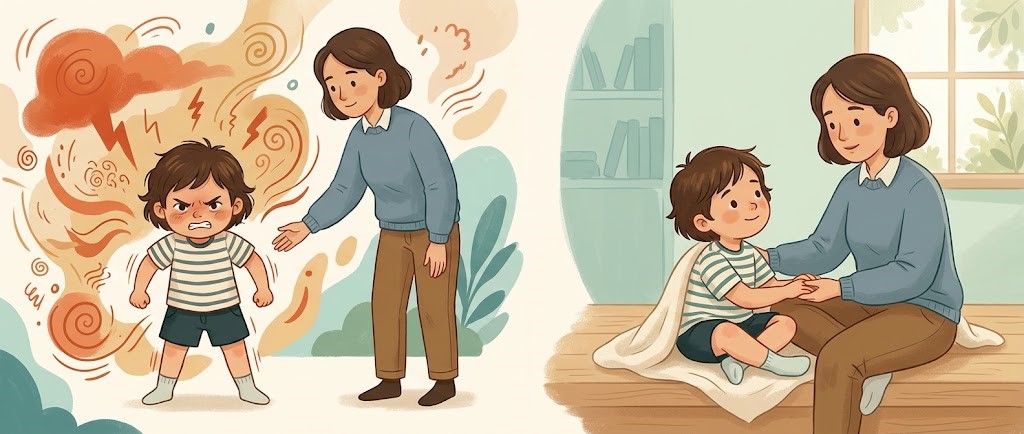
How to Help a Child With Anger
There is no single anger-management strategy that works for every child.
The goal is to gradually build a collection of skills the child can draw on.
1. Name the Feeling Without Judging It
Sometimes simply naming what appears to be happening can help.
“You’re really angry that we have to leave.”
“That was frustrating.”
“You really wanted another turn.”
This does not mean agreeing with the child’s demand.
You can validate the feeling and still hold the boundary:
“I know you are disappointed. We are still leaving.”
Naming emotions also gives children language they can eventually use themselves.
Instead of:
“Everything is terrible!”
they may gradually become able to say:
“I’m disappointed.”
Or:
“I’m angry because I wanted another turn.”
That is a skill.
2. Help Kids Notice Their Early Warning Signs
Do this when the child is calm.
Ask simple questions:
“What happens first when you start getting angry?”
“Do you feel it in your hands?”
“Does your heart feel different?”
“Does your voice get louder?”
Some children enjoy drawing an outline of a body and marking where they feel anger.
Others might describe anger as:
- fire in their face
- buzzing in their hands
- a volcano in their stomach
- a storm in their head
There is no need to correct the metaphor.
The important part is that the child begins to recognize:
“Something is happening before I lose control.”
3. Practice Calming Skills Before They Are Needed
Children are much more likely to use a strategy they already know.
Practice during calm moments.
Possible strategies include:
- slow breathing
- taking a short break
- moving to a quieter place
- asking an adult for help
- squeezing and relaxing the hands
- stretching
- getting a drink of water
- counting slowly
- walking
- pushing against a wall
- drawing
- listening to something calming
- sitting alone for a few minutes if the child prefers space
Not every strategy will work for every child.
One child may find slow breathing helpful.
Another may become even more irritated when someone says:
“Take a deep breath.”
One child may need movement.
Another may need quiet.
One may want a parent nearby.
Another may genuinely need space.
Instead of searching for the calming technique, help the child discover several possibilities.
That way, emotional regulation becomes flexible rather than a test the child can fail.
4. Give the Child Words for What They Need
Sometimes children know they are upset but do not know what to say.
Practice useful phrases during ordinary moments:
“I need help.”
“I need a break.”
“Please stop.”
“That wasn’t fair.”
“Can I try again?”
“I’m not ready yet.”
“I’m getting angry.”
“Can I have some space?”
A child who can communicate what is happening has another option besides shouting, hitting, or walking away without explanation.
These phrases will not eliminate every outburst.
They simply give the child more tools.
5. Solve the Problem Afterwards
Once the child is calm, look back at what happened without turning the conversation into an interrogation.
You might ask:
“What happened just before you got angry?”
“What did your body feel like?”
“What did you want to do?”
“What could you try next time?”
“Is there anything we need to fix now?”
If the child hurt someone or broke something, repair can be part of the learning.
That may mean:
- checking whether the other person is okay
- helping clean up
- repairing something
- apologizing when the child is ready
- trying the interaction again
The goal is accountability without shame.
6. Notice When the Child Handles Anger Differently
Adults naturally notice the moments when things go wrong.
Try to notice the smaller moments when the child uses a new skill.
Instead of simply saying:
“Good job.”
Be specific:
“You were really frustrated, but you asked me for help.”
“I noticed you walked away instead of throwing the toy.”
“You told your brother to stop before you got too angry.”
“You were disappointed, and you still managed to finish the game.”
Specific feedback helps children understand what they actually did differently.
It also helps them recognize that success does not mean:
“I wasn’t angry.”
Success may mean:
“I was very angry, and I handled it a little differently.”
What Not to Do When a Child Is Angry
Helping children learn emotional regulation is not only about adding new strategies.
Sometimes it also means avoiding responses that make learning more difficult.
Do Not Tell Children They Should Not Feel Angry
Statements such as:
“There’s nothing to be angry about.”
may feel logical to the adult.
But the child is already angry.
A more useful response is:
“I can see that this really bothered you.”
You can understand the feeling without agreeing that the situation was unfair or changing the boundary.
Do Not Demand a Conversation While the Child Is Overwhelmed
Questions such as:
“Why did you do that?”
require reflection.
A child who is still extremely upset may genuinely not be able to explain.
Wait.
The conversation can happen later.
Do Not Match the Child’s Volume
Children learn emotional regulation partly by experiencing regulation around them.
Adults do not need to remain perfectly calm every second. That is unrealistic.
But shouting louder than the child rarely teaches the skill we want them to develop.
If you do lose your temper, you can model repair later:
“I was angry too, and I shouted. I should have spoken differently.”
Children can learn a great deal from seeing adults take responsibility.
Do Not Turn Every Outburst Into a Long Lecture
If every mistake leads to twenty minutes of talking, children may begin to avoid the conversation entirely.
Keep the message focused.
What happened?
What was not okay?
What could happen differently next time?
Does anything need to be repaired?
Then move on.
Do Not Remove All Frustration
The goal is not to create a life where the child never hears no, never loses, never waits, and never becomes disappointed.
Children need manageable opportunities to experience frustration and gradually learn:
“I don’t like this, but I can cope with it.”
Support does not mean preventing every uncomfortable feeling.
Learning Anger Skills When Nobody Is Angry
Some of the best anger-management practice happens when everyone is calm.
Children can learn about emotions through:
- stories
- books
- games
- pretend play
- role-play
- drawing
- conversations about fictional characters
- practicing possible responses
- talking about situations that happen to other people
A character in a book can make an emotion easier to discuss.
Instead of:
“Why do you always shout when you lose?”
you can ask:
“Why do you think this character got so angry when the game ended?”
The child is practicing the same thinking, but from a safer distance.
Games can work in a similar way.
Children can identify feelings, experiment with different responses, and talk about imaginary situations without feeling that the activity is secretly about something they did wrong.
Related Resources
If books are a good fit for your child, read:
Best Anger Management Books for Kids Who Struggle With Big Feelings
This guide includes different types of books, from relatable stories that open conversations to more structured resources that teach practical anger-management strategies.
For children who prefer learning through play, explore:
Best Games and Playful Activities for Teaching Kids About Emotions
These games and activities use storytelling, movement, hands-on play, and imaginary situations to help children explore emotions without making the experience feel like a formal lesson.
Try This at Home: The Anger Detective
You do not need special materials to begin exploring anger with a child.
Try becoming an Anger Detective together after a small frustration has passed.
The goal is not to investigate who was right or wrong.
You are looking for clues.
Step 1: What Happened?
Ask:
“What happened just before you started getting angry?”
Keep the answer factual.
“My tower fell down.”
“He took my toy.”
“You said we had to leave.”
“I lost the game.”
Step 2: What Did Your Body Do?
Ask:
“Did you notice anything in your body?”
You can offer ideas if needed:
“Were your hands tight?”
“Did your stomach feel funny?”
“Did your face feel hot?”
“Did you feel like moving?”
The child may not know at first.
That is okay.
This skill develops gradually.
Step 3: What Did You Want to Do?
The answer might be:
- yell
- run away
- hit
- cry
- throw something
- hide
Do not criticize the impulse itself.
Instead, help the child distinguish between wanting to do something and actually doing it.
You can say:
“You really wanted to throw it. What could you do instead if that happens again?”
Step 4: What Might Help Next Time?
Choose one realistic idea.
Maybe:
“Ask for help.”
“Move away.”
“Tell him to stop.”
“Get Mom or Dad.”
“Put the toy down.”
“Take a short break.”
The goal is not to create a perfect plan.
It is simply to help the child begin recognizing the sequence:
Something happens → my body reacts → I feel like doing something → I can learn another option.
What If My Child Gets Angry About Very Small Things?
Adults and children do not always experience the same event as equally important.
A broken cracker may seem insignificant to us.
For a tired four-year-old who expected a whole cracker and has already handled ten frustrations that morning, it may be the final disappointment.
This does not mean you need to replace every broken cracker.
You can still say:
“You really wanted it to be whole. I know you’re disappointed. This is the cracker we have.”
Similarly:
“I know you want to stay at the playground. We are still leaving.”
Empathy does not require changing the decision.
When reactions repeatedly seem much larger than the trigger, it can also be useful to look at the wider context.
Ask yourself:
- Is the child tired?
- Hungry?
- Overstimulated?
- Coming home after holding things together all day?
- Struggling with transitions?
- Worried about something?
- Finding a particular task very difficult?
- Coping with several disappointments at once?
Sometimes the “small thing” is simply the place where everything else becomes visible.
Small to Us Does Not Always Mean Small to Them
Adults have years of experience putting events into perspective.
Children do not.
A lost pencil, a changed plan, or being given the wrong cup may genuinely feel enormous in that moment.
We do not need to pretend that every problem is objectively serious.
But we can acknowledge the child’s experience while helping them build perspective over time.
“This feels really big right now. We can handle it.”
That message is often more helpful than:
“This is ridiculous.”
When Is Anger More Than a Normal Big Feeling?
All children become angry.
Some children also go through periods when anger is more frequent.
What matters is not whether anger ever occurs.
Consider the overall pattern.
It may be worth discussing your concerns with your child’s pediatrician or another qualified professional if anger or outbursts:
- happen very frequently
- are extremely intense
- regularly involve serious aggression
- put the child or other people at risk
- seem very unusual for the child’s developmental level
- significantly interfere with school or childcare
- cause major problems with friendships
- dominate family life
- remain severe over time despite consistent support
You may also want additional guidance if you find yourself constantly reorganizing family life to prevent the child from becoming angry.
Professional support does not mean that anger itself is abnormal.
Sometimes children simply need more individualized help understanding what is driving their reactions and developing the skills they need.
Frequently Asked Questions
Is It Normal for Kids to Get Angry?
Yes.
Anger is a normal human emotion, and children will become angry when they experience frustration, disappointment, limits, conflicts, or other difficult situations.
What matters more is how often intense anger occurs, how severe the reactions are, whether the child can recover, and how much it affects everyday life.
Should I Let My Child Be Angry?
Yes, in the sense that you do not need to eliminate or punish the feeling.
You can still set limits around behavior.
“You can be angry. You cannot hit.”
Allowing an emotion does not mean allowing every action associated with it.
Should I Send My Child Away to Calm Down?
It depends on the child.
Some children genuinely regulate better when they have space.
Others experience being sent away as rejection and calm more easily with a trusted adult nearby.
When possible, you can offer a choice:
“Do you want some space, or would you like me to stay close?”
The goal is regulation rather than punishment.
If the child wants to be alone, you can still remain available.
Why Does My Child Hit When Angry?
Young children may hit when the intensity of the feeling is greater than the regulation and communication skills they currently have available.
That does not make hitting acceptable.
Stop the unsafe behavior, keep the boundary clear, and later practice alternatives such as:
- asking for help
- moving away
- using words
- calling an adult
- putting down the object they are holding
- taking space
The child needs both the limit and an alternative.
How Can I Teach Anger Management When My Child Is Calm?
Calm moments are the ideal time.
You can:
- read stories about feelings
- use role-play
- notice body signals
- practice one calming strategy
- talk about fictional situations
- use emotion games
- practice phrases the child can use
- discuss how different people may react to the same situation
The more familiar the skills become during calm moments, the more likely the child is to remember them when emotions begin to rise.
Does Validating Anger Mean Allowing Bad Behavior?
No.
Validation and boundaries can happen at the same time.
“I understand why you’re angry. I won’t let you throw the chair.”
You are acknowledging the emotional experience while remaining clear about what behavior is safe and acceptable.
What if My Child Refuses Every Calming Strategy?
That does not necessarily mean the strategies are useless.
Timing matters.
A child who is already overwhelmed may reject almost any suggestion, including strategies they use successfully at other times.
Practice when the child is calm and allow them to have some ownership over which ideas they prefer.
You can ask:
“When you’re really mad, would you rather have space, move your body, or have me stay close?”
The child does not need to choose from a long list.
Start with one or two realistic options.
Should Children Apologize After an Angry Outburst?
Repair is important, but a forced apology while the child is still overwhelmed may not teach very much.
Once everyone is calm, help the child think about what happened and what needs to be repaired.
An apology may be appropriate.
So might:
- checking whether someone is okay
- helping rebuild something
- cleaning up
- replacing an item
- trying the interaction again
The goal is for the child to understand responsibility, not simply to produce the word “sorry.”
Final Thoughts
Children do not need to learn that anger is bad.
They need to learn that anger is something they can notice, understand, express, and gradually manage.
That process takes time.
Young children will sometimes become completely overwhelmed.
Older children will sometimes forget strategies they already know.
Adults will sometimes respond less calmly than they intended.
Emotional regulation develops through many small experiences, not one perfect conversation.
The goal is not a child who never becomes angry.
It is a child who gradually learns:
“I know what this feeling is.”
“I notice what is happening in my body.”
“There are things I can do.”
“I can ask for help.”
“I can be angry without hurting someone.”
And perhaps most importantly:
“Having a big feeling does not make me a bad person.”
Anger is part of being human.
Learning what to do with it is a skill, and like other skills, children develop it through support, practice, mistakes, and many opportunities to try again.