Learning does not always have to look like schoolwork.
A child may lose interest after five minutes of practising numbers on paper but happily spend much longer using the same numbers in a pretend shop. Another child may resist repeating letter sounds at the table but become completely engaged when those letters are part of a game, a search, or a challenge.
That does not necessarily mean the child does not want to learn.
Sometimes the way a skill is presented makes a significant difference to how willing a child is to practise it.
Learning through play gives children opportunities to use real skills while they are actively involved in something that has a purpose inside the activity. They may be building, guessing, sorting, pretending, solving a problem, taking turns, telling a story, or moving around the room.
And importantly, play based learning does not always mean running, jumping, or being physically active.
A child can be deeply engaged in play while sitting at a table building words from letter cards, sorting objects, inventing a story, solving a puzzle, or playing a simple math game.
The important question is not whether the activity looks like traditional schoolwork.
It is whether the child is engaged in an experience that gives them meaningful opportunities to practise and understand the skill.
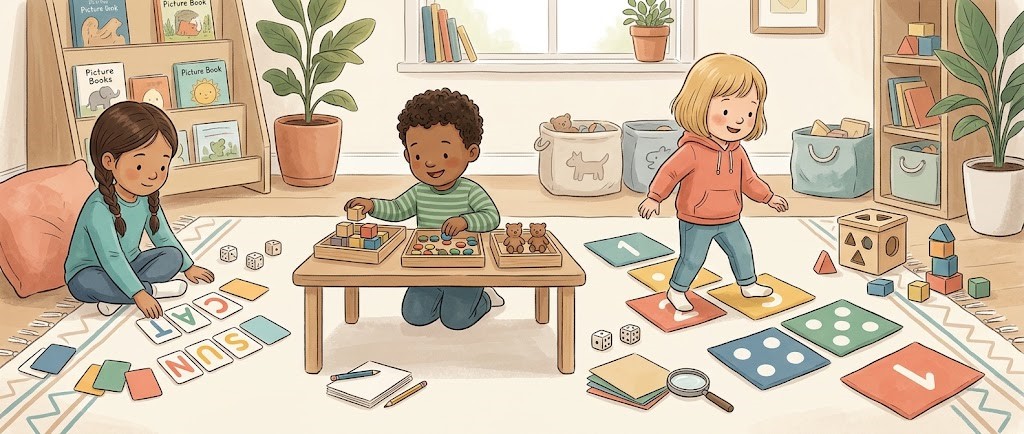
What Is Learning Through Play?
Learning through play does not mean that adults need to secretly turn every game into a lesson.
Children also need time to play simply because they enjoy it.
It also does not mean that any activity becomes educational simply because we call it a game.
Play based learning happens when children are given opportunities to explore, make choices, experiment, communicate, solve problems, imagine, and practise skills through an engaging activity.
That might include:
- pretend play
- simple board or card games
- sorting and matching
- building
- storytelling
- drawing
- puzzles
- movement games
- scavenger hunts
- role-play
- hands-on challenges
- cooperative games
Sometimes the adult introduces a clear learning goal. At other times, learning develops naturally from the play itself.
For example, a pretend grocery store can involve counting, addition, subtraction, language, social interaction, and problem-solving. A building activity can involve shape, balance, planning, comparison, and persistence.
The adult does not need to point out every piece of learning that happens.
The goal is to create opportunities where useful skills become part of what the child is already doing.
Why Can Play Make Learning More Effective?
Play does not magically make every child learn faster, and children will still sometimes need repetition, concentration, and tasks they would not choose themselves.
But play can change the context in which practice happens.
That can make a meaningful difference.
Children Participate Instead of Only Receiving Information
There is a difference between hearing information and having to use it.
If an adult asks:
“What sound does B make?”
the child can answer and the interaction is finished.
But imagine that several letter cards are spread across the floor and the child needs to find the letter that makes the /b/ sound before they can take the next turn in a game.
The skill is similar.
The child still needs to connect the letter with its sound.
But now the answer has a purpose within the activity.
The child has to:
- listen
- remember
- look at the available options
- choose
- act on the answer
This active participation can make practice feel more meaningful.
Play Gives Repetition a Reason
Children need repetition when learning many early skills.
They may need to see the same letters many times.
They may need repeated opportunities to count, compare quantities, recognise numbers, blend sounds, or solve simple calculations.
The difficulty is that repetition can become dull when every practice opportunity looks exactly the same.
Games give repetition a reason.
A child may answer the same type of math problem several times because each answer allows them to:
- move a piece
- collect an object
- take a turn
- throw toward a target
- solve part of a mystery
- continue a story
- beat their previous score
- help a teammate
The underlying learning still involves repetition.
What changes is the context around it.
Children Can Meet the Same Skill in Different Ways
A child might practise the number seven by:
- recognising it on a card
- counting seven blocks
- jumping seven times
- finding seven objects
- adding numbers that make seven
- using seven pretend coins in a shop
These activities are not identical, even though they are connected to the same mathematical idea.
Similarly, a child learning letters might:
- identify a letter
- say its sound
- find an object beginning with that sound
- build a word containing it
- match uppercase and lowercase forms
- use it in a game
This variety can help children encounter familiar skills in different contexts.
That does not mean children have fixed “learning styles” and should only be taught in one particular way.
It simply means that children can benefit from practising a skill through more than one type of activity.
Play Gives Children Room to Experiment
Mistakes are part of learning.
But the way a mistake feels can depend on the context.
On a worksheet, a wrong answer may feel very final:
“I got it wrong.”
Inside a game, the same mistake might feel more like:
“Oops. That wasn’t it. I’ll try another one.”
The child may be more willing to experiment, change strategy, and try again.
This does not mean adults should pretend incorrect answers are correct.
It means that the activity can create a context where errors are simply part of figuring something out.
Play Can Support Motivation
Learning does not always need to be fun.
Children will sometimes need to practise things that are difficult, repetitive, or not particularly exciting.
Play based learning should not become a promise that a child will enjoy every educational experience.
What play can do is make some forms of practice easier to enter and easier to sustain.
A child who would answer five math questions reluctantly may solve many more calculations if each answer is part of a shop, throwing game, treasure hunt, or challenge.
The learning goal has not disappeared.
The activity simply gives the child another reason to keep going.
Looking for Ready-to-Use Play Based Learning Ideas?
If you like the idea of practising reading and math through games, challenges, pretend play, simple materials, and different forms of active participation, My book Playful Learning brings together 40 activities designed around this approach.
Playful Learning ebook on Amazon
If you would rather see what the ebook contains before deciding whether it is right for your family, read:
Inside the Playful Learning Ebook: Play Based Activities for Reading and Math
Play Based Learning Does Not Have to Mean Running Around
When people hear “active learning,” it is easy to picture children jumping between numbers or running around looking for letters.
Those activities can be useful.
But they are only one form of playful learning.
More Active Play Might Include
- throwing a beanbag toward the correct answer
- jumping along a number line
- searching the room for letters
- moving between word cards
- scavenger hunts
- acting out a story
- carrying or sorting objects
Quieter Play Might Include
- pretend shopping
- matching cards
- building words
- storytelling
- drawing
- puzzles
- sorting
- guessing games
- tabletop math activities
- cooperative problem-solving
A child sitting quietly and organising pretend groceries can be just as actively involved in learning as a child jumping between number cards.
The defining feature is not how much the child moves.
It is how actively the child participates in the experience.
This is also why variation matters.
Some days a child may want an energetic game.
Another day, the same child may prefer a quiet activity at the table.
Both can be playful.
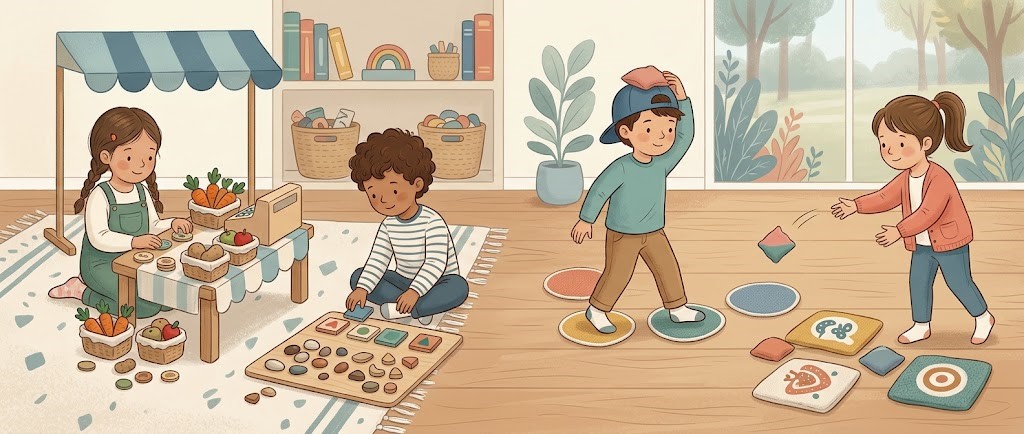
What Can Children Learn Through Play?
Play based learning can be used across many different areas.
The activity itself changes depending on the skill being practised.
Reading and Early Literacy
Children can practise early literacy through games involving:
- letter recognition
- letter sounds
- rhyming
- listening for sounds inside words
- blending
- building words
- spelling
- vocabulary
- storytelling
- early reading
For example, letter cards can become part of a matching game, a search activity, or a word-building challenge.
A child who needs repeated practice with a particular sound does not necessarily need to complete the same paper exercise each time.
The same skill can appear in several different games.
For examples of reading and math activities built around this principle, see:
Inside the Playful Learning Ebook: Play Based Activities for Reading and Math
Math
Math is particularly easy to integrate into play because numbers appear naturally in:
- counting
- shopping
- building
- scoring
- dice games
- sharing objects
- comparing quantities
- measuring
- collecting
- moving spaces in a game
Young children can practise:
- number recognition
- counting
- quantities
- addition
- subtraction
- patterns
- comparison
- simple problem-solving
A pretend shop, for example, can turn addition and subtraction into part of the story rather than a separate exercise.
Emotions and Social Skills
Not everything children need to learn fits neatly onto a worksheet.
Play can also give children opportunities to practise:
- recognising feelings
- taking another person’s perspective
- communication
- turn-taking
- cooperation
- problem-solving
- handling disappointment
- trying different responses to social situations
A fictional situation can make difficult ideas easier to discuss because the child does not have to talk directly about themselves.
For practical examples, see:
Best Games and Playful Activities for Teaching Kids About Emotions
Play Based Learning vs. Worksheets: Do You Have to Choose?
No.
Play based activities and worksheets do not need to compete with each other.
Worksheets can be useful.
They may help with:
- handwriting
- targeted practice
- independent work
- checking understanding
- practising a specific format
- repetition
Play based activities can offer something different.
They can add:
- variation
- interaction
- imagination
- movement
- hands-on experience
- problem-solving
- repeated practice in a different context
A child might practise addition on paper one day and use the same calculations in a pretend shop the next.
One approach does not automatically make the other unnecessary.
The useful question is:
“What does this child need to practise, and what format would be useful right now?”
If worksheets regularly lead to resistance, frustration, or disengagement in your home, you may find these alternatives helpful:
Screen Free Learning Activities for Kids Who Hate Worksheets
How Parents Can Add More Play to Learning at Home
You do not need to redesign your home into a classroom or buy a collection of educational toys.
Small changes can make ordinary practice more playful.
Turn the Question Into a Challenge
Instead of simply asking:
“What is 5 + 3?”
give the answer a purpose.
For example:
“Five animals are already in the zoo. Three more arrive. How many do we need to put inside?”
Or place number cards on the table and let the child find the answer.
The academic skill stays the same.
The child now has something to do with it.
Use Things You Already Have
Useful learning materials can include:
- blocks
- toy cars
- stuffed animals
- dice
- paper
- sticky notes
- bottle caps
- socks
- balls
- cardboard boxes
- kitchen containers
You do not need a product labelled “educational” for learning to happen.
A few toy animals can become counters.
A laundry basket can become a throwing target.
Sticky notes can become letters or numbers.
Let the Child Become the Teacher
One simple way to increase participation is to switch roles.
Instead of always asking the questions, let the child ask you.
They might:
- create a math problem
- choose a letter sound
- hide the correct answer
- explain a rule
- decide how many points you earn
- correct one of your deliberately silly mistakes
Children often enjoy having more control over the activity.
It can also give adults useful information about what the child understands.
Change the Story, Not Necessarily the Skill
A child may need repeated practice with the same skill.
You do not always need to invent a completely new educational goal.
Change the context instead.
Addition can become:
- shopping
- dinosaurs
- treasure
- cars
- animals
- superheroes
- baking
- space exploration
Letter practice can become:
- a search
- a mystery
- a matching challenge
- a race
- a pretend delivery game
The skill remains familiar while the play changes around it.
Repeat Games Children Enjoy
Parents sometimes feel pressure to continually provide new activities.
You do not need to.
Repeating a favourite learning game can be useful precisely because the rules are already familiar.
The child no longer needs to spend as much attention understanding how the game works.
That leaves more attention available for the skill being practised.
The same game can also grow with the child.
You might:
- add more letters
- use larger numbers
- introduce new words
- change the rules slightly
- let the child lead
- add another player
- increase the challenge
A good learning activity does not need to be used only once.
A Simple Play Based Activity to Try Today
You can try this activity without preparing any special materials.
Find and Bring
Give the child a small challenge that requires them to move around the room or house and bring something back.
For early literacy:
“Bring me something that starts with B.”
“Can you find something with the /s/ sound?”
“Find something with a word you can read.”
For math:
“Bring me three things.”
“Find two blue objects and two red objects. How many do you have altogether?”
“Bring me five objects, then put two back. How many are left?”
For younger children, keep the instructions very simple.
For older or more confident children, make the challenge more complicated.
You can also reverse roles and let the child give you the challenge.
There is no worksheet and no special equipment.
The learning comes from the skill the child needs to use in order to complete the game.
When Play Based Learning Does Not Work
Adding a game does not automatically make an activity engaging.
Children often notice when ordinary schoolwork has simply been given a thin layer of “fun.”
If a game feels like a worksheet with extra steps, children may respond to it in exactly the same way.
Play based learning can lose its value when:
- the adult controls every part of the activity
- there is no room for choice
- every response is immediately corrected
- the activity lasts too long
- the level is far too difficult
- the child is already tired or overwhelmed
- the rules are more complicated than the skill
- the adult focuses so heavily on the learning goal that the game disappears
Sometimes the best response is simply to stop.
An activity that worked beautifully last week may not work today.
That does not mean the idea is bad.
Children’s motivation, energy, and interests change.
How Much Should Parents Guide the Play?
Play based learning often works best somewhere between complete adult control and no guidance at all.
If the adult controls every move, the activity may stop feeling like play.
If the adult gives no structure, the particular skill you wanted to practise may never become part of the activity.
A useful principle is:
Set up the opportunity, then leave room for the child to participate.
The adult might:
- choose the skill
- prepare a few materials
- explain the basic idea
- demonstrate one example
- help if the child becomes stuck
The child can then:
- make choices
- answer
- experiment
- suggest ideas
- take turns
- change roles
- sometimes adapt the rules
- create their own challenge
Play does not require the adult to disappear.
It requires enough flexibility for the child to be more than a passive recipient.
Want More Play Based Learning Ideas?
If you would like ready-to-use activities rather than continually inventing new games yourself, there are several resources on the blog depending on what you are looking for.
For Reading and Math Activities
Playful Learning contains 40 play based activities for early literacy and math using games, imagination, simple materials, movement where appropriate, and quieter forms of play.
The ebook is designed as a flexible collection rather than a course that needs to be completed in order.
Playful Learning ebook on Amazon
Want to Look Inside the Ebook First?
Before buying, you can see examples of the activities, how the ebook is organised, what materials are used, and who it may suit:
Inside the Playful Learning Ebook: Play Based Activities for Reading and Math
Looking for Alternatives to Worksheets?
If traditional worksheets often result in resistance or boredom, start here:
Screen Free Learning Activities for Kids Who Hate Worksheets
Want to Explore Emotions Through Play?
For games and hands-on activities focused on emotional learning:
Best Games and Playful Activities for Teaching Kids About Emotions
Frequently Asked Questions
Is Learning Through Play Only for Preschoolers?
No.
Play changes as children grow.
A preschooler may learn through pretend play, sorting, movement, and simple games.
An older child may enjoy:
- strategy games
- challenges
- word games
- role-play
- building
- problem-solving
- competitions
- puzzles
The activity should match both the skill and the child’s developmental level.
Does Learning Through Play Have to Involve Movement?
No.
Movement is one useful form of playful learning, but it is not required.
Children can learn through play while:
- building
- drawing
- matching
- storytelling
- sorting
- using cards
- solving puzzles
- pretending
- playing tabletop games
What matters is active participation, not physical activity alone.
Can Children Really Learn Reading and Math Through Games?
Games can provide useful opportunities to practise reading and math skills when those skills are genuinely part of the activity.
For example, a child may need to recognise letters to complete a search game or solve an addition problem before choosing the correct game piece.
A game is most useful when the educational skill is necessary to participate, rather than simply being added as decoration.
Are Worksheets Bad for Young Children?
No.
Worksheets are tools.
They can be useful for some types of practice and for some children.
The problem comes when one format becomes the only way a child is expected to learn or practise.
Combining paper-based work with games, hands-on activities, conversation, and practical experiences can provide useful variation.
What if My Child Only Wants to Play and Refuses Schoolwork?
Play based learning does not mean children should never practise less preferred tasks.
Part of growing up is gradually learning to tolerate activities that are difficult, repetitive, or not especially exciting.
Play can be one way to build skills, confidence, and motivation.
It does not need to replace every other form of learning.
Do Parents Need Special Educational Toys?
No.
Many effective activities can be created using materials already available at home.
Paper, cards, dice, toys, blocks, balls, containers, and ordinary household objects can all become part of learning games.
What Is the Playful Learning Ebook?
Playful Learning is a digital collection of 40 reading and math activities designed to help adults turn practice into games, pretend play, challenges, movement, and hands-on activities.
It is an activity guide rather than a traditional workbook.
Playful Learning ebook on Amazon
Final Thoughts
Learning through play is not about making every minute educational.
Children need time to play without adults measuring what they learned from it.
It is also not about making sure children never experience repetitive or difficult practice.
Learning sometimes requires effort.
Play based learning simply gives us another useful way to help children practise.
Games, stories, movement, imagination, building, sorting, and shared challenges can all become meaningful contexts for reading, math, communication, problem-solving, and many other skills.
Sometimes a worksheet is the right tool.
Sometimes a game is better.
Often, children benefit from experiencing both.
The useful question is not:
“Is this play or learning?”
It is:
“Is my child engaged in something that gives them a meaningful opportunity to practise the skill they need?”
If you would like a ready-made collection of ideas for bringing more play into early reading and math practice:
Explore the 40 activities in the Playful Learning ebook on Amazon
Playful Learning is an ebook created by the author of this blog. Links to the ebook in this article are direct product links and are not affiliate links.