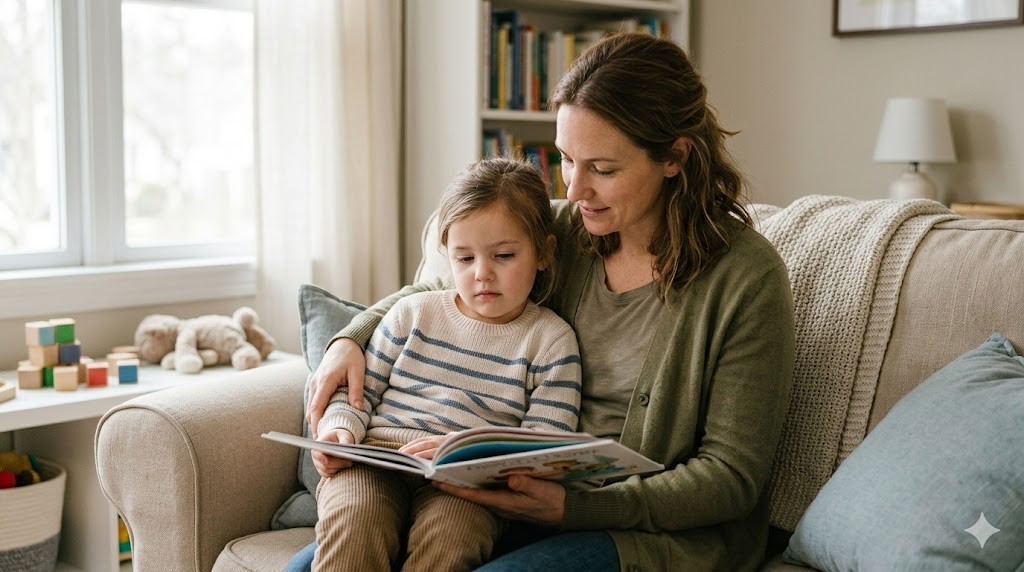
If your child has big emotional reactions, you are not alone.
Many parents see their child go from calm to crying, angry, frustrated, overwhelmed, or completely shut down within minutes. Sometimes the reason is clear. Other times, it seems to come out of nowhere.
This can be hard for parents, especially when the reaction feels much bigger than the situation. A lost toy, a changed plan, bedtime, getting dressed, leaving the playground, or being told no can suddenly become a major emotional struggle.
But big feelings are not a sign that your child is being difficult on purpose.
For many children, strong emotions are part of learning how to understand themselves, communicate their needs, and handle the world around them. They are still developing the skills needed to name feelings, explain what is wrong, and calm their bodies down again.
That is where books can be surprisingly helpful.
Children often understand emotions better when they see them in a story. A character can feel angry, sad, scared, jealous, silly, confused, or grumpy, and the child gets to watch that feeling from a safe distance.
Stories give children language for feelings before they can always find those words on their own.
Why Young Children Have Such Big Feelings
Young children feel emotions strongly because their brains are still learning how to manage them.
They may know that they are upset, but they may not know why. They may feel angry, but they may not yet have the words to say, “I feel disappointed because I wanted more time to play.”
Instead, the feeling comes out as crying, yelling, refusing, hiding, running away, or having a meltdown.
This does not mean the feeling is fake or dramatic. To the child, the feeling is real and intense.
Common reasons children have big feelings include:
- They are tired
- They are hungry
- They are overstimulated
- They feel misunderstood
- They do not have the words to explain themselves
- They are learning limits and boundaries
- They are disappointed by a change in plan
- They want control but still need help
For parents, the challenge is that the behavior is often louder than the feeling underneath.
A child may shout, but underneath they may feel embarrassed.
A child may refuse to listen, but underneath they may feel overwhelmed.
A child may cry over something small, but underneath they may be tired or overstimulated.
When parents can look for the feeling behind the behavior, it becomes easier to respond with calm guidance instead of only reacting to the outburst.
Why Naming Feelings Matters
Before children can manage emotions, they need to recognize them.
A child who can say “I am angry” or “I feel scared” has taken an important first step. They are beginning to connect what they feel in their body with a word they can use.
That does not mean the feeling disappears immediately. But it gives the child a way to communicate.
Without emotional language, children often rely on behavior.
They may hit because they cannot say they are angry.
They may cry because they cannot say they are disappointed.
They may refuse because they cannot say they feel nervous.
They may become silly or wild because they cannot say they are overstimulated.
Books can help children build this emotional vocabulary in a natural way.
A story might show a character who feels grumpy, scared, lonely, excited, or out of control. When you read together, you can gently ask:
- How do you think the character feels?
- What made them feel that way?
- Have you ever felt like that?
- What helped them feel better?
- What could they do next time?
These questions do not need to become a lesson. They work best when they are simple, calm, and part of the reading experience.
Books Let Children See Feelings From the Outside
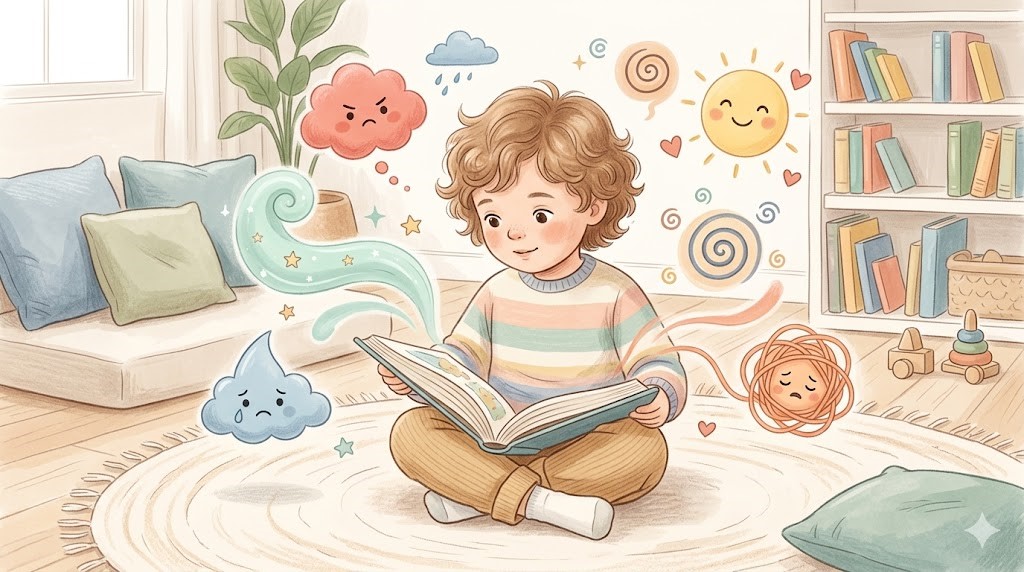
One reason books work so well is that they create distance.
It can be hard for a child to talk directly about their own anger or sadness. But it may be much easier to talk about a monkey who feels grumpy, a monster who feels confused, or a child who travels into a wild imaginary world after being sent to bed.
That distance makes emotions less threatening.
Children can think about the character first. Then, slowly, they may start connecting the story to their own experiences.
This is especially useful for children who resist direct conversations about feelings. Some children do not want to be asked, “Why are you angry?” right after an outburst. But later, during a quiet reading moment, they may happily talk about how a character felt and what happened in the story.
Books also help children see that emotions are normal.
A child learns that everyone feels angry sometimes. Everyone feels sad sometimes. Everyone feels grumpy sometimes. Everyone gets overwhelmed sometimes.
The goal is not to stop children from having feelings. The goal is to help them understand feelings and learn what to do with them.
How Books Can Help With Anger and Frustration
Anger is one of the emotions many parents find hardest to handle.
When children are angry, they may yell, throw things, stomp, refuse to cooperate, or say hurtful words. This can make parents feel frustrated too, which can quickly turn into a power struggle.
Books can help because they show anger in a way that feels less personal.
A story can show that anger often has a reason. Maybe the character feels ignored. Maybe they are tired. Maybe things did not go the way they expected. Maybe they do not know how to explain what is wrong.
When children see this in a book, they begin to learn that anger is not bad in itself. It is a feeling. What matters is how we respond to it.
This is an important message for children.
They do not need to feel ashamed of anger.
They do need help learning safe ways to express it.
A good book about anger or big feelings can help children understand:
- Feelings can be strong
- Feelings can change
- It is okay to feel angry
- It is not okay to hurt others
- Talking about feelings can help
- Calm can return after a hard moment
That last point matters. Children need to know that a difficult feeling is not permanent. A bad moment can pass.
Why Reading Together Works Better Than Explaining
Many parents try to explain emotions during the emotional moment itself.
Sometimes this works. Often it does not.
When a child is already overwhelmed, they may not be able to listen, reason, or learn. Their body is busy reacting. A long explanation may only add more pressure.
Reading together works differently.
It usually happens during a calmer moment. The child is sitting close to a parent. The story gives structure. The pictures support understanding. The emotional lesson is gentle rather than direct.
That makes the child more open to learning.
You do not need to turn every book into a discussion. Sometimes the most powerful thing is simply reading the same book again and again.
Repetition helps children absorb the message.
Over time, a child may begin to remember a character when they feel the same way.
They might say, “I feel like the grumpy monkey.”
Or, “My feelings are all mixed up.”
Or, “I need a calm moment.”
That is when a book has become more than a story. It has become a tool.
What to Look for in Books About Big Feelings
Not every book about emotions works the same way.
Some books are very direct and teach children to name feelings. Others use humor, imagination, or adventure to show what emotions feel like.
For young children, the best books are usually simple, visual, and emotionally clear.
Look for books that:
- Show feelings clearly through the story
- Use language children can understand
- Make emotions feel normal
- Avoid shaming the child or character
- Give parents a natural way to start conversations
- Feel enjoyable rather than like a lecture
- Can be read more than once
Some children respond best to funny books. Others respond better to gentle books. Some need books that name emotions directly. Others connect more with imaginative stories.
That is why it can be helpful to have a small mix of emotional learning books at home.
One book might help your child name feelings.
One book might help with anger.
One book might help with bedtime emotions.
One book might help your child feel understood.
👉 Looking for specific books? See our favorite kids books about big feelings and anger here
How to Use Emotion Books at Home
You do not need a complicated routine.
Emotion books work best when they are used naturally and repeatedly.
A simple approach could be:
- Read during a calm moment
- Let your child look closely at the pictures
- Pause when a character shows a strong feeling
- Ask one gentle question
- Share a simple observation
- Avoid forcing your child to talk
- Return to the book after difficult moments
For example, you might say:
“I think he looks really frustrated here.”
Or:
“She has a lot of feelings at the same time.”
Or:
“That reminds me of how hard it can be when plans change.”
These small comments help children connect the story to real life without feeling pressured.
You can also use books after a difficult moment, but only when your child is calm again.
For example:
“Earlier today was a big feelings moment. Should we read the book about the character who felt angry too?”
This keeps the tone gentle. The book is not used as a punishment. It is used as support.
When Big Feelings Happen at Bedtime
Bedtime is a common time for big feelings.
Children may suddenly become silly, angry, clingy, worried, or resistant. This can happen because they are tired, but also because bedtime brings separation, darkness, stillness, or a change from play to rest.
Books can help create a predictable transition.
A story about feelings can give children a calm way to process the day before sleep. It can also help parents talk about emotions without making bedtime feel heavy.
For some families, it helps to keep one or two emotion books near the bed and use them when the child seems unsettled.
The goal is not to solve everything at night. The goal is to help the child feel safe, seen, and ready to rest.
A Simple Way to Start
If your child has big feelings, you do not need to fix everything at once.
Start small.
Choose one book that matches the emotion your child struggles with most. Read it when things are calm. Keep the conversation simple. Let your child return to the story again and again.
Over time, books can help your child build emotional language, recognize feelings earlier, and feel less alone in difficult moments.
They can also help parents respond with more confidence.
Because when a child can begin to understand their feelings, those feelings become a little less overwhelming.
And when parents have simple tools to guide the conversation, big feelings become easier to meet with patience, connection, and calm.
Final Thoughts
Big feelings are a normal part of childhood. They can be difficult, loud, and exhausting, but they are also an opportunity to help children learn emotional awareness.
Books are not a magic solution. But they are one of the easiest and gentlest tools parents can use at home.
Through stories, children can see emotions, name emotions, and begin to understand that feelings come and go.
With the right books, big feelings can become easier to talk about, easier to understand, and easier to manage over time.
See the best kids books about big feelings and anger here
Affiliate Disclaimer
This post contains affiliate links. As an Amazon Associate, I may earn a small commission at no extra cost to you.
Pingback: Best Kids Books About Big Feelings and Anger – Kids Books & Learning Blog
Hello this is a fantastic article. My name is Donna Balkaya and I have published several kids picture books about big feelings and hidden disabilities . My new book “My Tic and Me” talks about Tics and Tourette’s and is about a boy learning to make friends with his tics. If you would like to review a copy I’ll be happy to send one please DM me